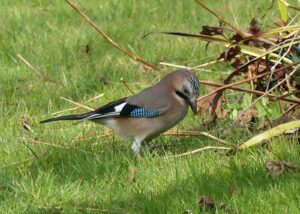
The Jay’s Busy Autumn
Across Knepp Wildland, the remarkable jay is making its rounds. Flying back and forth from the oaks, carrying acorns (as many as five at a
 Skip to content
Home / Rewilding is a carbon sink!
Nancy Burrell
Rewilding is a carbon sink!
Published July 2026
To anyone walking past, it must have looked like a crime scene. Someone waist-deep in mud, on their knees, firing compressed air into the ground and hauling something large and many-limbed out of the earth intact – crown, stems, roots and all. That something was a blackthorn.
The tool doing the firing was an air spade which, despite the soothing name, is neither light nor remotely spade-like. It’s a metal lance that shoots a jet of compressed air at close to the speed of sound – a supersonic howl aimed straight at the ground – fierce enough to blast heavy Sussex clay clean off a root system without bruising a single root hair. Picture a leaf-blower that has been to the gym, developed a temper and enlisted.
That person wielding the air spade was me. For about three trees. Then I conceded – with as much dignity as one can manage waist-deep in a hole – that this was a job for Hercules, not a PhD student with a clipboard, and handed the air spade to Aaron Europa and Stu White, in the works team at Knepp, who had true grit. Over three winters the two of them worked their way through 270 scrub trees – oak, sallow, hawthorn, blackthorn and dog rose – out in gale-force winds and torrential rain, excavating not just what you can see above ground but everything hidden beneath it too. The moment the sun came out, spring arrived and the birds began to nest, they had to down tools and wait for the next winter to begin all over again.
Because this was the fieldwork for my PhD at the University of Oxford. And Knepp is no random field site for me: I grew up here, and I’ve spent my life watching this land change. I wanted to build a better way to measure carbon – one that could finally let the rewilding biodiversity story be read through a natural capital lens, and claim the full sweep of services these landscapes deliver.
What I found stopped me short. Our hard work – mostly Aaron and Stu’s – was paying off, and we were about to change the way scrub is measured, and valued, for good.
Rewilding is an amazing carbon storer.
Rewilding’s carbon blind spot
Rewilding has become one of the most powerful tools we have for restoring biodiversity. Projects like Knepp show how quickly wildlife returns once habitat is allowed to recover. Since the rewilding project began in 2001, wildlife has returned at an astonishing rate.
Yet when the conversation turns to climate change, rewilding is often waved away – too slow, too messy, too diverse next to the neat arithmetic of tree-planting. I’ve never quite understood this. If soils are functioning again, wetlands are returning, and vegetation is regenerating on its own, surely these landscapes must be locking away substantial amounts of carbon? At least in comparison to the arable farm it was before.
The blind spot, as I see it, is scrub. In modern times, we’ve become so fixated on trees – tall, single-stemmed, plantation-shaped trees – that we’ve overlooked the small, thorny, scrubby ones that define scrubland and hedgerow. This obsession has been largely influenced by farming and forestry. Scrub has been considered “wasteland”, good for nothing, and “unmeasurable.” And because it doesn’t behave like plantation timber, we’ve had almost no idea how much carbon it stores below ground – or how that storage might be stimulated by the free-roaming herbivores that drive rewilding in the first place.
Trees that build their own armour
My fascination with this began away from Knepp, in the wood pastures of Crete, where open-grown oaks have been shaped by centuries of goat and sheep browsing. Rather than reaching for the sky, these oaks grow thorny and compact, throw out multiple stems, and pour their resources into their roots. They are, in effect, building their own armour against being eaten. Once they finally escape above the browse line, out of reach, they revert to behaving like ordinary oaks.
It’s the same phenomenon you can walk through at Knepp, where years of browsing by longhorn cattle, Exmoor ponies and deer have sculpted the woody vegetation into something that looks almost like a topiary sculpture park. The question that kept nagging at me was simple: if browsing changes a plant’s shape this dramatically above ground, what is it doing below?
Why the old models break
The workhorse models of carbon accounting – the i-Tree Eco model, the lookup tables behind the UK’s Woodland Carbon Code – were built for trees grown without herbivores, in cities and plantations. They predict a plant’s biomass from its height and its diameter, which works beautifully when a tree grows in a tidy, predictable way.
When I applied that logic to scrub at Knepp, it fell apart. For plants growing below the browse line – under about 2.5 metres – there was essentially no relationship between height and width. A browsed shrub isn’t investing in getting taller or fatter in any orderly fashion; it’s investing in defence, in resprouting, and in roots.
So I built new equations – one set for each scrub species, above and below ground – that actually account for how herbivores reshape these plants, driving their wonky growth and root-heavy distribution of biomass.
The carbon hiding in the roots
This is where those winters of digging finally paid off. The headline finding is a number: a mean root:shoot ratio of 1.06 below the browse line, against the 0.26 baked into standard forest-derived accounting. For every gram of wood, leaf and stem you can see, there’s at least as much again beneath your feet – out of sight, out of mind, and off the books. Oak and dog rose ran higher still. Above the browse line, once plants outgrow the herbivores, the ratios fall back towards more familiar values.
And 1.06 is conservative. Roots ran far beyond the plant, into networks that would have taken days each to lift, so we drew a line at half a metre from the stem and left the rest – including most of the fine hair roots – in the ground. Every figure we report is short of what’s actually down there.
And the scale of the error matters: the models the UK relies on have been underestimating the belowground carbon in scrub by more than fourfold.
Browsing, then, doesn’t simply stunt a plant and reduce its carbon. It reshapes where that carbon goes, pushing it downward into root systems that turn over slowly and sit largely out of reach of disturbance – exactly the kind of stable, long-lived store that matters most for climate. Because roots decompose far more slowly than most above-ground material, this belowground pool may be a comparatively durable form of carbon storage.
These findings challenge the traditional view that herbivore browsing simply stunts growth and strips out biomass. Under certain amounts of browsing pressure, trees reallocate – and in doing so may enhance their capacity to store carbon.
What this means
If these tools assume a root:shoot ratio a quarter of the real one, we are systematically undercounting the carbon held in rewilded and naturally regenerating land. Scrub – which spans an estimated 1.4 billion hectares worldwide and is expanding fast across UK rewilding projects – keeps falling through the cracks of national inventories and carbon frameworks. Not because it isn’t storing carbon, but because we haven’t been measuring it properly.
My study won’t settle this on its own, but it offers something practical: species- and context-specific equations that others can pick up and use, and a clear case for writing browsing and belowground allocation into carbon accounting rather than assuming them away.
Next steps
The question I find most intriguing is what browsing does to a plant’s carbon storage over its whole life. We tend to assume a tree reaches a maximum height, and with it a maximum carbon capacity. But if browsing delays that – if a shrub spends years armoured, multi-stemmed and rooting deep before it ever breaks free above the browse line – then herbivory might actually prolong its working life as a carbon sink.
Rewilding, it seems to me, offers a genuine alternative pathway for tackling climate change, and one that delivers biodiversity, resilience and a host of other benefits alongside the carbon. To recognise that properly, we need monitoring tools built for these dynamic, herbivore-shaped landscapes – not borrowed from the plantations they look nothing like.
We just have to remember to look underground as well.
Rewilded scrubland as a carbon sink: allometric models to improve biomass estimation under herbivory (2026): https://iopscience.iop.org/article/10.1088/1748-9326/ae83cc/meta
The inadequacy of current carbon storage assessment methods for rewilding: A Knepp Estate case study (2024)
:https://besjournals.onlinelibrary.wiley.com/doi/full/10.1002/2688-8319.12301
Across Knepp Wildland, the remarkable jay is making its rounds. Flying back and forth from the oaks, carrying acorns (as many as five at a

On the day that Tim Mackrill and his team install an osprey nesting platform at Knepp, Isabella Tree grabs the chance to chat to the
By the last week of August, the seemingly endless spell of drought was finally broken. In Greek mythology, the word ‘ichor’ describes the fluid that
Knepp Wildland Safaris, our gardens and campsite are all about the quiet and patient observation of nature.
Some of the species we are likely to encounter are shy or can be frightened by loud noises or sudden movements. Our campsite with open-air fire-pits, wood-burning stoves and an on-site pond is unsuitable for small children.
For this reason, our safaris, garden visits, holiday cottages and campsite are suitable only for children of 12 and over.
This event is available through a separate booking platform.
Once you’ve finished booking your stay, please visit the What’s On Calendar to navigate back to the event to book your tickets.
The What’s On Calendar can be found under the Visit menu at the top of the website.
You’ll receive relevant offers and news by email. This will include information about the Rewilding Project, online store products, the Wilding Kitchen Restaurant / Cafe, and other exciting experiences / events across the Knepp Castle Estate. For more information, view our Privacy Policy.