
Episode 52: Bringing Back the Bison
Isabella Tree catches up with Carl Sayer, Professor of Limnology & Freshwater Ecology at University College London – aka the Eel Man – as he
 Skip to content
Home / September 2026 Designers and Gardeners – the Odd Couple or Partners for Life?

Moy Fierheller | Deputy Head Gardener
September 2026 Designers and Gardeners – the Odd Couple or Partners for Life?
Published September 2026
Visit Knepp’s rewilded Walled Garden
By the last week of August, the seemingly endless spell of drought was finally broken. In Greek mythology, the word ‘ichor’ describes the fluid that flows through the veins of the gods; it is the substance that defines their immortality. ‘Petrichor’, coined by two Australian researchers in the 60s (‘Petra’ means ‘stone’) is the word we now use to describe that smell like no other, that of the earth welcoming the rain after a long, hot, dry summer. Indeed, judging from the thousands of images flooding social media of people dancing in soaked celebration, the occasion had all the magical qualities of a miraculous gift from the heavens.
The garden is woken from its long sleep, and a pungent mix of aromas fills the air, as stored oils and bacteria in the crushed concrete of the Rewilded Garden are released by the explosive water droplets raining down. The rosemary and thyme are redolent of the piney, woody scent of a Mediterranean hillside, the cat mint and calamint send up waves of cool, green menthol and under all is the insistent, salty tang from the sea lavender Limonium platyphyllum ‘Violetta’.
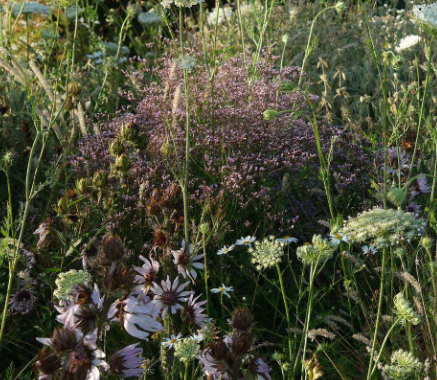
The frothy violet sprays of sea lavender (Limonium platyphyllum) with purple berkheya (Berkheya purpurea) and wild carrot (Daucus carota).
The Kitchen Garden responds in fairy-tale ballooning, as if it has ingested one of Alice’s ‘EAT ME’ cakes; the metre-high perennial kales sport masses of pale-green elephant’s ears, crisphead lettuce leaves swell to the size of your hand, the sunflowers make a rush for the sky and seem to grow another foot overnight, sending out a profusion of bright yellow and russet blooms.
We begin to work through the garden, editing those competitive plants that have spread in the dry conditions and taken advantage of the space afforded by the slow growth of less resilient plants around them. Yarrow, marjoram, ox-eye daisies and clovers cover the ground and smother the necks of surrounding plants. We rootle out the majority to stop any one species becoming dominant, so that a greater diversity of others can seed into bare soil or existing plants grow unimpeded.
Editing the Rewilded Garden: Deputy Head Gardener Brett Haythorpe with garden students Hannah, Ruby and Karola.
This ‘cue to care’ – an indication of human interaction with the space – helps to clarify the garden too, making it more readable. It’s also about aesthetics – the great plantswoman Gertrude Jekyll wrote “The measure of a garden’s beauty lies in its capacity to give pleasure.” Part of that pleasure is seeing plants healthy and nurtured – there’s a natural response to seeing death and decay in a garden as the antithesis of beauty. We see it a little differently.
In our garden experiment of balancing beauty and increasing biodiversity through natural processes, the role we play in this ecosystem is landscape engineers or ‘agents of disturbance’. Where the drought has left lifeless leaves and dry brown stems, instead of brushing them out of sight, we mimic the actions of birds or animals or insects, fashioning them into nest-like balls, bedding circles or clustered hollow stems and place them as ornament. We’re mimicking the natural processes of wildlife while also bringing our own creativity into the space. All the habitat, food and shelter that death and decay brings remains in the ecosystem but is shaped in a way that’s more palatable to the human eye.
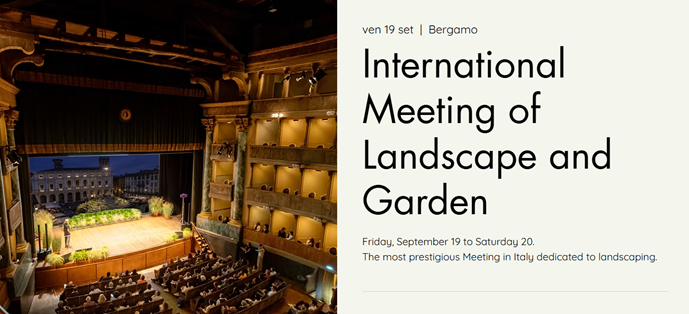
Creativity in gardeners is one of the subjects included in a talk by our Head Gardener Charlie Harpur this month at the International Meeting of Landscape and Garden, held in Bergamo, Italy. Speakers from such diverse countries as India, Brazil and Morocco have come together to exchange ideas between architects, plant designers and landscape architects and discuss this year’s subject: rethinking cities to restore the balance between urban development, ecology, and economic sustainability.
There’s an accepted and long-standing tradition of clients engaging designers, who deliver their vision, which becomes a reality, and a gardener is engaged to hold on to that picture, to dominate and suspend the ecosystem in time. What Tom Stuart-Smith and James Hitchmough did with the Rewilded Garden at Knepp was something different, and arguably one that may become a new dynamic for the future.
For the section of the garden that James designed, a sloping east-to-west ridge that runs for roughly 30 metres, he provided a narrative, conditions and a selection of plants from similar nutrient-poor, dry habitats around the world. The gardener is built into the design from day one, and their job is to translate those building blocks of a landscape into a working ecosystem that develops and will change in ways that aren’t predictable.
Tom likewise describes making a “box of experimentation” for us that would “unleash a host of unpredictabilities”. Starting his practice in 1998, he developed an international reputation for combining naturalism with modern structural design and has won nine gold medals at the Royal Horticultural Society’s Chelsea Flower Show. But the Walled Garden at Knepp is a departure from the fixed-picture designs for which he is famous. When asked by Charlie Harpur prior to the conference if he has any other projects with a similar emphasis on the gardener as design collaborator, the only example he could think of was the Hepworth Wakefield Garden, a public garden adjoining the gallery on the edge of the River Calder in West Yorkshire. Katy Marrington, the cultural gardener on site, has been with the project from its beginnings and remains involved in its ongoing development. Tom saw her role as crucial for the garden to be a natural extension of the gallery. With an art history background and a team of volunteers, Katy devises activities to encourage the broadest possible audience to use the garden.
Why is this the case? It’s difficult to know. In his talk Charlie contemplated what a gardener is, noting how many gardeners come from creative backgrounds, including members of our own team who have moved into horticulture from the world of film, advertising, acting, costume and architecture. Gardeners are often seen as outdoor housekeepers, maintaining a neat and tidy outdoor room. Although that’s a small part of it, gardening is a creative process. Once a gardener spends any length of time in an ecosystem, they’re a part of it, and contribute a share in the ecology of the dynamic landscape. The role inherently becomes more complex and multi-layered.
Charlie advocated integrating the gardener’s role and contribution to the ongoing development of the garden into the actual design and budget of a garden. This would perhaps necessitate some quieting of a designer’s ego or require them to enter into a more collaborative relationship. But, Charlie argued, gardens of the future will need this kind of approach, anyway, for longevity and sustainability in a rapidly changing climate.
In the conference Q&A, asked what is needed to think as we do at Knepp Charlie explained that the team can see when the system is out of balance. There’s a growing push for gardeners’ education to include a basic knowledge of ecology – how an ecosystem functions, how landscapes change over time, biodiversity and the role of keystone species. Understanding how things interact in functioning ecosystems makes a gardener’s role a thoughtful, observation-based process.
As the movement for defending the rights of nature gains traction and a bill to recognise Nature as a legal subject is being debated in the House of Lords, a landmark case has given stingless bees legal rights in Peru, the first such recognition for an insect. Perhaps in the future, a gardener will also be a guardian of nature, able to uphold the rights of trees, rivers, wildlife and habitats, changing mindsets and behaviour garden by garden.
Photos courtesy of Charlie Harpur, Moy Fierheller
What we’re reading:
Stingless Bees · Amazon Research Internacional
Inside the Battle to Grant Legal Rights to Amazon Stingless Bees
About ClientEarth | Global environmental law charity | ClientEarth
Rare Earth – Can lawyers save the planet? – BBC Sounds
Nature’s Rights Bill [HL] – Parliamentary Bills – UK Parliament
Gardening Tips – October 2026
Isabella Tree catches up with Carl Sayer, Professor of Limnology & Freshwater Ecology at University College London – aka the Eel Man – as he
Moy Fierheller | Deputy Head Gardener August: Heatwave survivors Published August 2026 Visit Knepp’s rewilded Walled Garden We are suspended in a sea of fine
Isabella Tree catches up with Carl Sayer, Professor of Limnology & Freshwater Ecology at University College London – aka the Eel Man – as he
Knepp Wildland Safaris, our gardens and campsite are all about the quiet and patient observation of nature.
Some of the species we are likely to encounter are shy or can be frightened by loud noises or sudden movements. Our campsite with open-air fire-pits, wood-burning stoves and an on-site pond is unsuitable for small children.
For this reason, our safaris, garden visits, holiday cottages and campsite are suitable only for children of 12 and over.

You’ll receive relevant offers and news by email. This will include information about the Rewilding Project, online store products, the Wilding Kitchen Restaurant / Cafe, and other exciting experiences / events across the Knepp Castle Estate. For more information, view our Privacy Policy.