The Jay’s Busy Autumn
Across Knepp Wildland, the remarkable jay is making its rounds. Flying back and forth from the oaks, carrying acorns (as many as five at a
 Skip to content
Home / July: Gardening in a Climate of Extremes

Moy Fierheller | Deputy Head Gardener
July: Gardening in a Climate of Extremes
Published July 2026
Visit Knepp’s rewilded Walled Garden
White hot light, the air insistent and thick with heat, leaches colour out of the garden, all the nuance extracted as if some fierce, retributive beast is sucking a daily ration of shades, slinking away when the sun begins to lower. The intense sulphurs of the domes of Balkan spurge (Euphorbia seguieriana) return as the light slants and colours, picking out the crayon-yellow rays of tall compass plant flowers (Silphium laciniatum). Bold, bright orange splashes of butterfly milkweed (Asclepias tuberosa) rebound, there are smoky purple clouds of sea lavender (Limonium platyphyllum ‘Violetta’), baby blue bursts of chicory flowers (Cichorium intybus) and through all, waving delicately atop wiry stems, the filigree lace plates of wild carrot (Daucus carota).
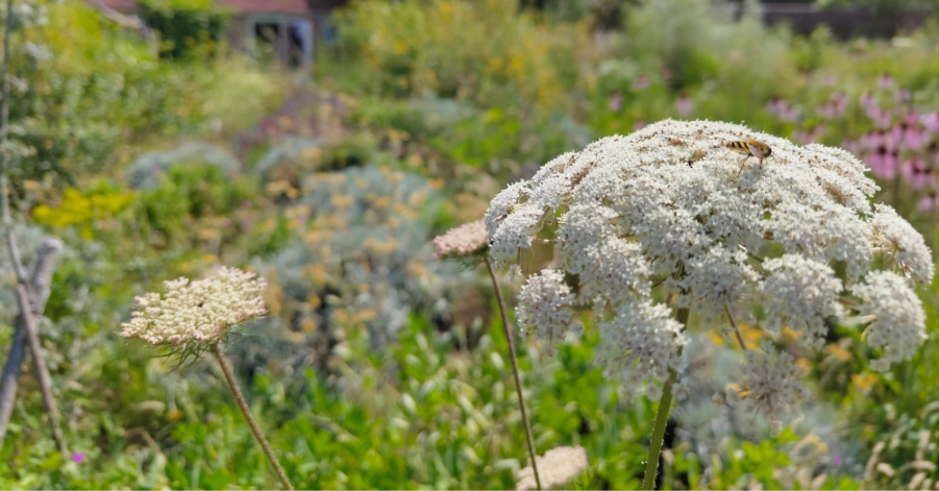
The lacy heads of native wild carrot (Daucus carota) in the Rewilded Garden, a drought-tolerant plant loved by a range of pollinators.
We could call the retributive beast another name perhaps: climate change. There are so many record-breaking statistics this year – the first year the temperature has reached 35°C in May, June and July; the warmest spring on record in England and Wales; the mean temperature for England 2.4°C above average, and the heat unusually and persistently high during the night. UK surface waters have seen a rise of 2°C above average. Our rainfall record in the garden shows 38 consecutive dry days with only a paltry 0.5mm recorded on the first of the month, while wildfires ravage landscapes across the UK. The English and Welsh Fire and Rescue services logged 564 incidents for the year to mid-June. It’s difficult not to think the tipping point is now behind us, and that we must face the reality of this year as the template for the future.
How should we adjust our thinking about gardens, and what have we learnt in our experiment here at Knepp? One of the driving principles behind Tom Stuart-Smith’s design, helped by his friend and colleague James Hitchmough, specialist in the ecology and design of urban greenspace using naturalistic planting, was to include as many different habitats as possible within the Walled Garden.
Changing the topography, introducing a range of soils and substrates from rich compost to low-fertility crushed concrete and sand mixes, including their differing styles of planting, featuring drought-tolerant plants, and cramming the space with a multiplicity of species, has been important in two ways. First, diverse habitats bring about an increase in wildlife. Second, those same diverse habitats make a garden more resilient to weather extremes.
Where there was once a vast sweeping expanse of flat, uniform croquet lawn the mounds and hollows of the Rewilded Garden now provide patches of shade and damp, where dew and moisture can cling on for longer. The garden is now essentially a patchwork of tiny microclimates. Had the lawn remained, we would no doubt now be seeing a vista of cracked and baked, lifeless soil, covered in metres of crisped, dead grass.
The old phrase “right plant, right place” is an adage we gardeners know well, although we’re well aware how we often care more about the look of a plant than where it comes from, and in what conditions it will thrive. James Hitchmough chooses plants specifically from challenging habitats around the world – dry stony riverbeds, mountain scree, American prairies – and in the deep mix of crushed concrete and sand on ‘Hitchmough Ridge’ in our garden, he’s used plants that not only can tough it out in these harsh environments but are also beautiful to look at. The Rewilded Garden seems to be holding its own in the heat, but the flowering period is shorter than in cooler years, the plants’ reduced energies appearing to be focused on seed production.
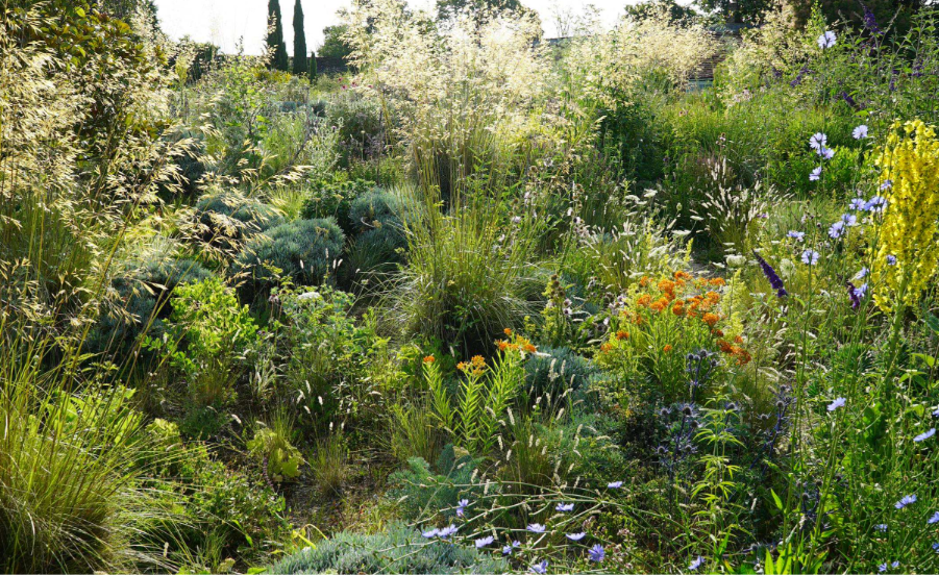
The beauty and diversity of James Hitchmough’s drought-adapted or ‘xeric’ plants on ‘Hitchmough Ridge’ .
Working under the frazzling sun in the garden this summer, we’re conscious of having to modify the tasks we might ordinarily be undertaking at this time of year. Instead of planting out those perennials we’ve grown from seed, they stay in the nursery, waiting for lower temperatures when we won’t have to excessively hand-water them in their establishment phase. If we clear species that might be dominating a bed, particularly in the Kitchen Garden, where the soil promotes leafier growth, the humidity and microclimate that they create disappear; the remaining plants struggle to survive in the heat. We’re mulching bare ground with sheep’s wool, compost or chopped vegetation to stop the soil drying out. There are few areas we can retreat to work in shade.
This is another crucial aspect of a garden that can create climate resilience and increase habitat for wildlife.
In the BBC Radio 4 programme ‘In Our Time’ (available on BBC Sounds as a podcast) Jenny McElwain, Chair of Botany at Trinity College Dublin and Director of Trinity Botanic Garden, describes how the evolution of trees contributed to the creation of the world we see today. She considers trees to be ecosystem engineers. She asks us to imagine a space with 20 herbs, then swap those herbs for 20 trees – to visualise how structural complexity increases in that space. Suddenly, there are layers of habitats, an increase in moisture and shade, humidity, microclimates, understory and middle-story plants, as well as plants in the canopies. Trees change how everything interacts, above and below ground and they generate complexity. Their roots extract minerals and nutrients from rocks, building soil and relationships with fungi and soil organisms. They engineer space and resources.
Trees give us and other living things respite from increasingly long, hot summers, their shade blocking solar radiation and potentially reducing surface temperatures by 11–25°C and air temperature by 1–5°C.
There is a selection of trees that remain from before the garden redesign in 2021 – some evergreen: three bull bays (Magnolia grandiflora), a stone pine (Pinus pinea), several stately pencil cypresses (Cupressus sempervirens), along with some bay trees (Laurus nobilis), ‘goat-topiarised’ yews (Taxus baccata), and some silver-leaved ornamental pears (Pyrus nivalis). A large smoke bush (Cotinus obovatus ‘Flame’) by the potting shed explodes into fiery burnt orange in autumn, as do the twin sentinel cut-leaf crab apples (Malus transitoria), giving deciduous structure.
We must wait for the newly planted trees to ‘engineer’ the remaining spaces. In the Kitchen Garden, Tom’s design includes a range of trees. Everything we planted in this section is edible, culinary or medicinal. We have fruit and nut trees – cherry, apricot, fig, mulberry, quince, filbert and some more unusual edibles. Chinese mahogany (Toona sinensis) has edible leaves and fruits from the strawberry tree (Arbutus unedo) can be harvested in autumn. In the Rewilded Garden Tom sited trees mainly around the fringes of the garden. Several originate from the Mediterranean basin, China or Japan, on rocky slopes, forest margins or dry scrublands. Like other plants that tolerate extreme conditions, they will tend towards slower growth. The amur maackia (Maackia amurensis), a deciduous tree from China with fragrant white flowers in early summer, will take 20 years to reach maturity.
We’ve also allowed some volunteer pioneer species such as willow, birch and alder some space. They’re offering their ecological services in the early development of the garden. They contribute shade for establishing plants, and their roots drill down, opening up the dense Wealden clay that sits beneath the concrete and sand mix, and they provide food for insects. The Database of Insects and their Food Plants (BRC) records 205 species of insect on goat willow (Salix caprea). We manage these trees by mimicking the browsing of herbivores, keeping them within bounds for now. And as the garden evolves, we may well edit them out to maintain plant diversity by grubbing them up, imitating the pigs in the rewilding project.
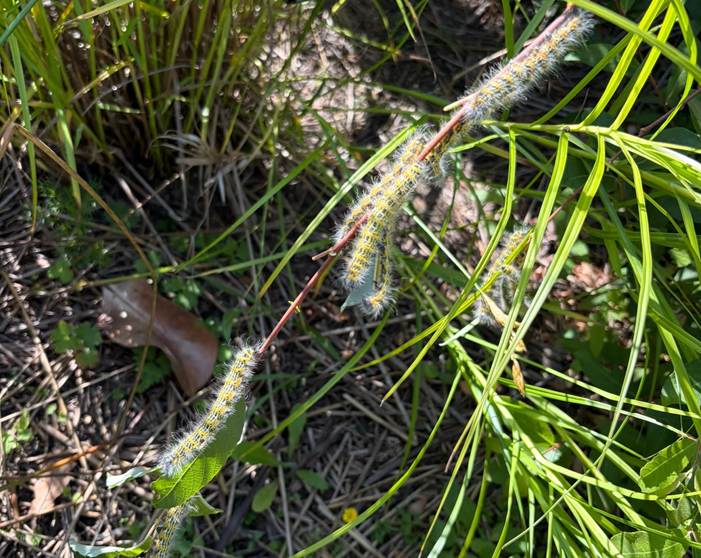
Buff tip caterpillars stripping the leaves of self-seeded goat willow.
Many people eschew the idea of planting a tree in their garden, citing problems of falling leaves and flowers and lack of space, the potential for blocking out light or views, or damaging nearby buildings and drains. The Royal Horticultural Society (RHS) has a wealth of advice on its website about choosing the right tree or trees for your garden (see links below), and how to avoid these potential irritations and more serious threats. Falling leaves and flowers are an essential part of the nutrient cycle, feeding worms and other soil organisms, keeping the tree and the soil healthy. A ‘cue to care’ can be established for those who like neatness, by keeping the ground around the tree’s drip-line clear of leaves to show intent. All the other ‘issues’ can be simply solved by following the ‘right plant, right place’ rule. Trees can often frame a view or block out a neighbour’s unattractive outbuilding; light can be ‘let in’ by lifting a crown – cutting back lower branches of a mature tree – and most trees don’t cause damage to buildings; it is shrinkable clay soils that are often the cause.
Researching the ecology of trees is well worth doing when considering which species might work in your garden. Is it a suckering tree that throws up new shoots, like staghorn sumac (Rhus typhina)? If you already have it, or plan to have it, you must speedily make friends with your neighbour! Or is it a tree that regularly drops its limbs, like many Australian gum trees (Eucalyptus spp.)? How large will a tree grow? The RHS suggests drawing a scale plan of your garden and plotting the size of a preferred tree at maturity, as well as visiting a local arboretum to see the scale of a mature specimen.
Early winter is the perfect time for tree planting. Unlike many other species, when you plant a tree, it is quite likely it will share all your lifetime, and possibly those of your grandchildren and beyond. Plant a tree, make a lifelong friend.
There’s always more to learn, and we’re constantly surveying and noting how plants in the garden are responding to the extremes of weather we’ve seen in recent years. Over the winter we’ll look back and use the data from this year to inform how we manage the garden in future. Early winter is the perfect time for tree planting too. Unlike many other species, when you plant a tree, it is quite likely it will share all your lifetime, and possibly those of your grandchildren and beyond. Plant a tree, make a lifelong friend.
Photos courtesy of Joshua Chalmers, Moy Fierheller, Charlie Harpur.
What we’re reading
In Our Time – The Evolution of Trees – BBC Sounds
Trees for Smaller Gardens | RHS Advice
Trees Near Buildings: What to Know | RHS Advice
BRC – Database of Insects and their Food Plants
Garden Tips – August 2026
Across Knepp Wildland, the remarkable jay is making its rounds. Flying back and forth from the oaks, carrying acorns (as many as five at a

On the day that Tim Mackrill and his team install an osprey nesting platform at Knepp, Isabella Tree grabs the chance to chat to the
By the last week of August, the seemingly endless spell of drought was finally broken. In Greek mythology, the word ‘ichor’ describes the fluid that
Knepp Wildland Safaris, our gardens and campsite are all about the quiet and patient observation of nature.
Some of the species we are likely to encounter are shy or can be frightened by loud noises or sudden movements. Our campsite with open-air fire-pits, wood-burning stoves and an on-site pond is unsuitable for small children.
For this reason, our safaris, garden visits, holiday cottages and campsite are suitable only for children of 12 and over.
This event is available through a separate booking platform.
Once you’ve finished booking your stay, please visit the What’s On Calendar to navigate back to the event to book your tickets.
The What’s On Calendar can be found under the Visit menu at the top of the website.

You’ll receive relevant offers and news by email. This will include information about the Rewilding Project, online store products, the Wilding Kitchen Restaurant / Cafe, and other exciting experiences / events across the Knepp Castle Estate. For more information, view our Privacy Policy.