The Jay’s Busy Autumn
Across Knepp Wildland, the remarkable jay is making its rounds. Flying back and forth from the oaks, carrying acorns (as many as five at a
 Skip to content
Home / June: Snails – Destroyers or Restorers?

Moy Fierheller | Deputy Head Gardener
June: Snails – Destroyers or Restorers?
Published July 2026
Visit Knepp’s rewilded Walled Garden
Rain. Fine, horizontal sheets like billows of smoke buffeting us in sideways assaults. Slamming rods, hard as bars. Gentle, insistent pattering for hours on end. Aggressive bursts splattering dry ground with artwork worthy of Jackson Pollock, working itself up into thunderous drenching, swiftly followed by hot sun, like a toddler’s tantrum turning on a sixpence to laughter. It feels as if the weather gods are a brigade of confused cooks, serving pudding before the main course, confusing the seasons, serving weeks of autumn at the beginning of summer.
British folklore tells us we should have seen this coming. In 1866, William Henderson gave us the first written account of the well-known rhyme
‘If the oak’s before the ash
You’ll only see a splash,
If the ash precedes the oak
You’ll surely have a soak.’
There is, in fact, no scientific proof that the rhyme holds any truth; oaks coming into leaf tend to respond to temperature, ash to daylight length. The leaf emergence has more to do with the spring being warmer or cooler than a prediction of the likelihood of summer rain. Some proverbs, however, are backed by science. “Rain before seven, fine by eleven” is verified by the Met Office, four hours being a common amount of time for a weather system to move over an area.
The Met Office holds a fantastic collection of publications in their digital archives, with such treasures as Weather Lore by Richard Inwards, published in 1869. His focus on changes in plant and animal behaviour leans heavily towards signs of rain, snow or bad weather – 30 out of 32 portend gloomy skies! Some observations suggest lengthy study — as with asses: “If asses hang their ears downward and forward and rub against walls, rain is approaching”. Some are more prosaic;
“When black snails cross your path
Black clouds much moisture hath.”
With all the rain, our minds, and the queries from our many visitors inevitably turn to slugs and snails. They’re frequently the subject of the most common pest enquiry put to the Royal Horticultural Society (RHS). But it’s often the damage done that’s seen, not the perpetrator itself. Amongst 99 species of terrestrial snails in the UK, only a very few are considered to be garden plant pests, and it’s likely that many beneficial and less damaging species are persecuted unnecessarily.
Almost all snails make a significant contribution to the nutrient cycle – feeding on decaying and dead material, breaking it down into nutrient-rich organic matter for healthy soil ecosystems and plant growth. They’re food for all manner of mammals, birds and reptiles and many insects too; the larvae of glow worms feed on snails by paralysing them and sucking them dry. The young larvae of the beetle Drilus flavescens eat terrestrial snails and pupate in the protection of the empty shell. Many flukes and tapeworms use them as intermediate hosts to infect their target hosts.
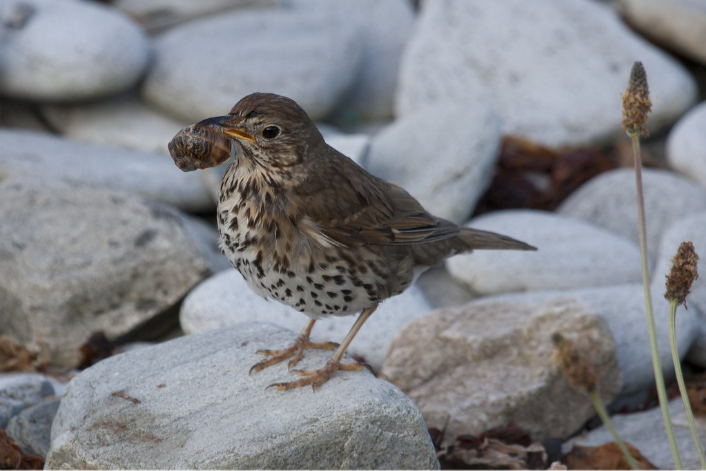
A song thrush with a garden snail, often observed to smash the shell on a stone to get to the meat.
The most widely recognised species proven to be the culprit when it comes to ravaged seedlings, devoured fruits, disappearing salads and riddled hosta leaves is the garden snail, Cornu aspersum. Being one of the larger species, they can live from three to six years and they’re hermaphrodites; they mate over several hours, exchanging sperm packets, and both can lay clutches of 30–100 eggs. Within two to four weeks miniature replicas emerge with tiny translucent shells, although many won’t survive their first year due to environmental challenges or by being predated.
Like most species, they favour habitats that are damp and shady, nooks and crannies to escape drought or cold or lay eggs, or in piles of decaying material like fallen logs or leaf litter. They walk on a film of thin mucus. By constantly replenishing this mucus, they use up water which they restore by eating and drinking. Water loss varies with air humidity, and if they become dehydrated beyond a certain point, they’ll die. At the other end of the spectrum, too much water, and they can drown; the mucus becomes so diluted, they’re unable to climb out. Wind can play an active role in desiccating them too.
So, here lies the key to the garden management of an organism that likes a good butterhead as much as the rest of us. There’s plenty of non-chemical methods to try. Physical barriers like water in the saucer of a pot-grown plant, or copper tape that produces an electrolytic reaction between the slime and the metal, giving the snail a small shock, act as a deterrent rather than killing it. Anything that dries out or is a rough surface for that slimy ‘foot’ can be put around the stem of a plant. Materials like sand, grit, crushed eggshells or commercial products such as ‘strulch’ – a mineral-enriched, preserved and shredded wheat straw that is both scratchy and an irritant – can help with preserving young plants until they’re old enough to become less palatable. Snails are mostly active in wet weather or at night when humidity is higher, so hand-picking and removing them to suitable habitats such as woodland edges or shrubby park areas is another way of reducing populations. Think of all the wildlife that could be feasting on them!
The idea of snails having navigational skills is true. They can follow their own and others’ slime trails which can be a double-edged sword; some snails are carnivorous and may be using the trails to hunt potential prey. But they’ve also been shown to have the ability to respond to chemical cues and geolocate using magnetic fields. Studies show that twenty metres is about the distance needed to stop a snail returning to its original and probably favoured habitat.
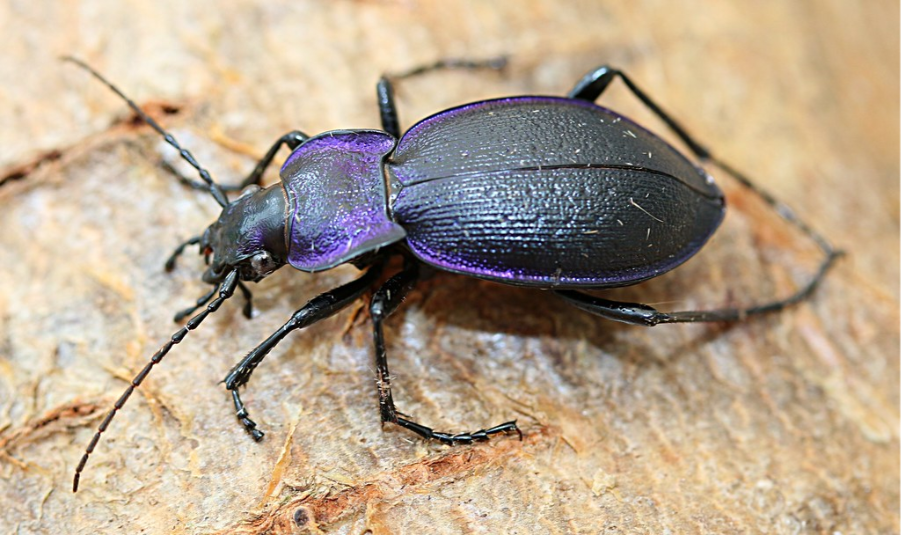
The violet ground beetle, one of many ground beetles that eat slugs and snails.
Encouraging predators like birds, frogs and toads can help control populations too. Ground beetles are voracious consumers of slugs and snails – a single beetle consuming up to 50 in one night. Building habitat like log piles, thick woodchip mulches or a beetle bank can tip the balance in a vegetable garden. A beetle bank is a banked mound of earth planted with a mix of tussocky grasses allowed to grow long where beetles can hide in the day and come out at night to forage.
Plant choices can also help; the RHS have run many trials to identify varieties of ornamental plants that are more resistant to slug and snail damage, as well as producing a list of plants that have tough or hairy leaves (see below). Having neither teeth nor jaws, their rough ‘tongue’ is only able to break down soft, young or decaying matter.
Slug pellets, even organic ones, should never be an option. Non-organic pellets are now banned, but the ‘safe’ pellets, with the active ingredient being ferric phosphate, have been found to be harmful to earthworms and other soil organisms. Added chemicals that help bond the iron molecules called chelators increase the toxicity of iron. Incidentally, they can be harmful to pets if eaten in quantity too.
It’s good to remember that even garden snails are still a valuable part of the garden ecosystem. Interestingly, we don’t seem to suffer too much from snail herbivory here in the Kitchen Garden. This may be down to our goal of increasing biodiversity with a diverse range of habitats, providing a good pest-to-predator ratio or the dense and impenetrable 320 metres of Wealden clay that sits beneath us. Snail populations tend to favour calcium-rich, well-drained soils.
All ‘pests’ tend to occur in abundance when we humans have created a favourable habitat for a particular species. In our case, the nature of the Walled Garden tends to exclude the larger predators, so it’s pigeon and vole damage we’ve been trying to find solutions to. But that’s another story….
Photos courtesy of plazaccameraman, Derek Parker, Nick Goodrum.
What we’re reading;
The Habitats of Land Mollusca in Britain on JSTOR
How to stop slugs and snails / RHS
Environmental orientation by terrestrial Mollusca with particular reference to homing behaviour
Monitoring the effects of pesticide pellets to address farmers’ concerns on soil fauna, specifically earthworms – Dummett – 2023 – Soil Use and Management – Wiley Online Library nge and Pesticides https://www.wwf.org.uk/sites/default/files/2019-05/EofE%20bee%20report%202019%20FINAL_17MAY2019.pd
Garden Tips – July 2026
Across Knepp Wildland, the remarkable jay is making its rounds. Flying back and forth from the oaks, carrying acorns (as many as five at a

On the day that Tim Mackrill and his team install an osprey nesting platform at Knepp, Isabella Tree grabs the chance to chat to the
By the last week of August, the seemingly endless spell of drought was finally broken. In Greek mythology, the word ‘ichor’ describes the fluid that
Knepp Wildland Safaris, our gardens and campsite are all about the quiet and patient observation of nature.
Some of the species we are likely to encounter are shy or can be frightened by loud noises or sudden movements. Our campsite with open-air fire-pits, wood-burning stoves and an on-site pond is unsuitable for small children.
For this reason, our safaris, garden visits, holiday cottages and campsite are suitable only for children of 12 and over.
This event is available through a separate booking platform.
Once you’ve finished booking your stay, please visit the What’s On Calendar to navigate back to the event to book your tickets.
The What’s On Calendar can be found under the Visit menu at the top of the website.

You’ll receive relevant offers and news by email. This will include information about the Rewilding Project, online store products, the Wilding Kitchen Restaurant / Cafe, and other exciting experiences / events across the Knepp Castle Estate. For more information, view our Privacy Policy.