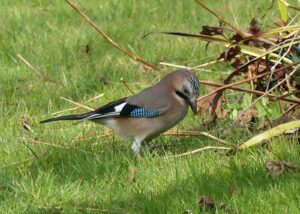
The Jay’s Busy Autumn
Across Knepp Wildland, the remarkable jay is making its rounds. Flying back and forth from the oaks, carrying acorns (as many as five at a
 Skip to content
Home / May: The secrets of the bees’ knees and why you need to know

Moy Fierheller | Deputy Head Gardener
May: The secrets of the bees’ knees and why you need to know
Published June 2026
Visit Knepp’s rewilded Walled Garden
May is a ragbag of weather: rainbows and dark horizons; hot sun and powder blue skies edged with chilly, blustery winds; a dramatic hailstorm drumming great pellets of ice on the greenhouse glass that left a cloth of pearls covering the terrace table; and cold nights that culminate in a hard frost, leaving the potato tops browned and forlorn. The finale is a weekend that records the highest-ever temperature for a spring Bank Holiday Monday at 34.8°C.
The greenhouse overflows with seedlings while we wait for the weather to settle so we can plant out tender salvias - ‘African Sky’, ‘Phyllis Fancy’, ‘Amistad’, and the Sabra spike sage (S. confertiflora) – that have a long flowering season. They give the garden intense blues, lavenders, purples and reds into late summer.
The garden has a marked difference in feel, colour and vegetation structure compared to the constant warmth and dry days of spring last year. The vagaries of annual weather patterns are part of the natural processes that we’re learning to respect as curators of this wilder space. Instead of disappointment at the unwillingness of perennials to bulk up and flower, we see how it creates change and diversity in the plant communities and, consequently, in food and habitats for wildlife.
While perennials and grasses are holding their nerve waiting for better prospects to get on with the business of growth, annuals and biennials are seizing the opportunity to take centre stage where there is more bare ground, light, and lack of competition. The spreading bellflower (Campanula patula) is one such opportunist. Its pale blue sprays of star-shaped flowers, entirely absent for the last few years, have colonised throughout the Rewilded Garden this season. It’s considered to be native, although there is some dispute about its origins. The first recorded sighting in Britain is from 1666. Its presence in the garden is from our own seed mix that we scattered in 2021. In the wild, it’s considered an endangered species, having declined significantly in recent decades because of environmental degradation and intensive agriculture – the usual suspects. Like many wildflowers, it needs sunny, disturbed ground to germinate. Its seed can remain viable in the soil for up to forty years. Soil disturbance is key, exposing the seed to the light and air it needs to germinate. As we’ve learned from the free-roaming animals in the rewilding project here at Knepp, disturbance is the key that opens the door to all sorts of plants, insects, birds and other species.
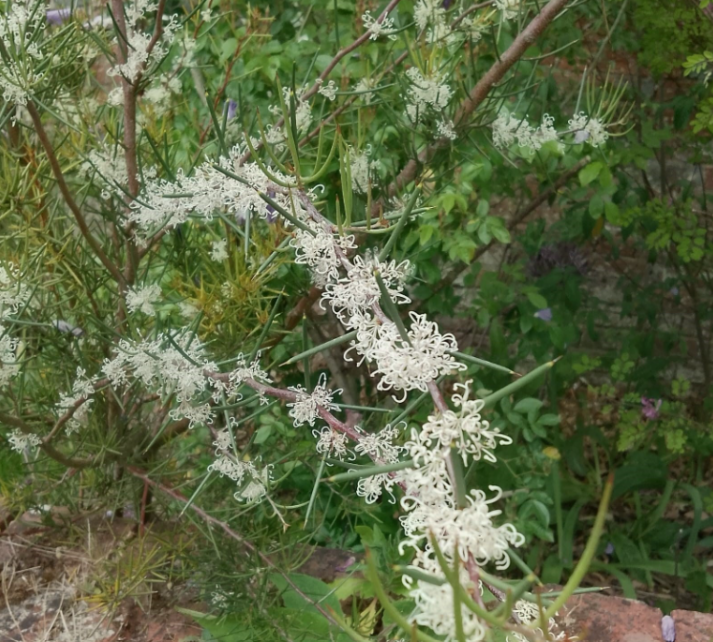
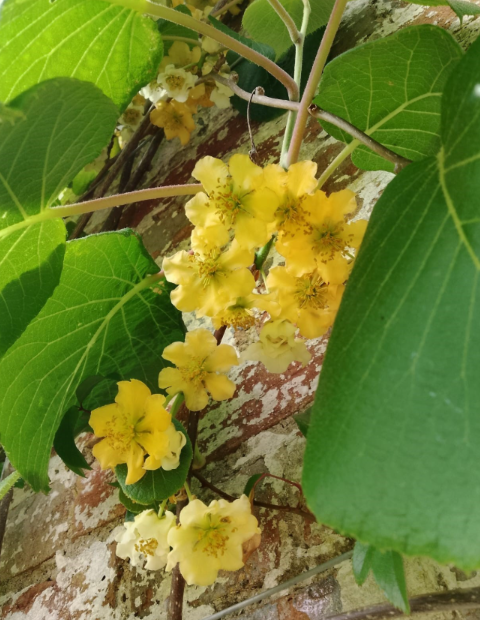
Our woody plants and shrubs have also benefited this year, producing an extravagance of flowers, the wet winter and their solid frames enabling them to store water and nutrients longer than their leafier cousins. Two Indian mallows (Abutilon x suntense), garden hybrids from Chile, have been covered with a mass of large, mauve saucers all month. A few trees have flowered for the first time since being planted. The drought-tolerant South Australian shrub, mountain needlewood (Hakea lissosperma), well named for its spiky, tough foliage, is sporting curious clusters of pollinator-attracting, almond-scented flowers all along its stems that look like small clumps of white, curled shavings. Bees have been thronging the creamy yellow flowers of the furry kiwi (Actinidia deliciosa ‘Atlas’) on the warm, south-facing wall of the Rewilded Garden. It’s a male plant that doesn’t produce fruit but is essential for pollinating female kiwi plants.
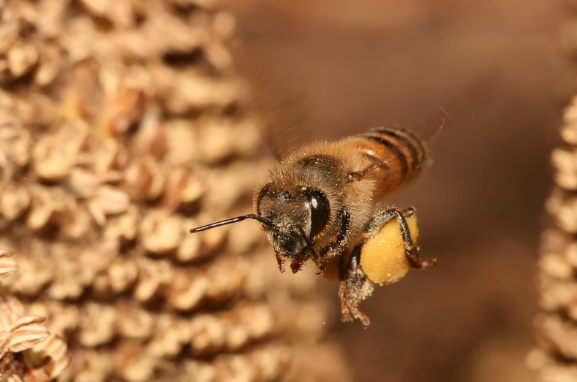
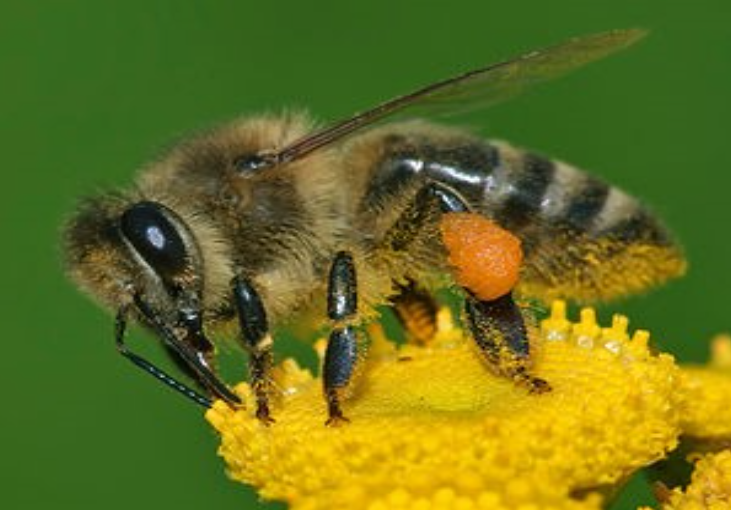
Pollen, the powdery grains that produce male gametes (sperm cells), come in all shapes, colours and sizes. They must be transferred from the anther of one flower to the female stigma of another, or the same, compatible flower, for the plant to be able to produce seed. Although many insects, and sometimes birds and bats, are responsible for transporting pollen grains, which attach themselves to their body or legs as they forage for nectar, it is bees, with their thick socks of pollen, that are the easiest to spot as pollinators. And it’s possible to deduce what families of flowers a bee has been visiting by the colour of their ‘corbiculae’, the tiny saddlebags, also known as pollen ‘baskets’, that attach to their legs. These baskets of pollen and nectar can account for 30% of a bee’s weight.
Scientists of ‘melissopalynology’, literally the study of bee pollen, carry out microscopic analysis of pollen in honey to determine the geographical location and species of plants the honey comes from. But beekeepers have long known how to identify where their colonies may be foraging through the colour of pollen they collect. Understanding which plants their bees prefer gives beekeepers an idea of which plants to encourage to support their colonies. Yellow pollen, typical of plants in the legume family, like clovers, peas and beans is most frequently seen. Orange pollen comes from sunflowers and asters. Many plants, including grasses and trees like willow or birch and apple blossoms, have green pollen. Blue is rarer and comes from plants in the bluebell family. Red is from composite flowers, where tiny numerous flowers form central dense clusters, as can be seen in dahlias, asters, and chrysanthemums.
The ‘corbicula’, or pollen basket, on the legs of a Western honeybee can account for 30% of its bodyweight.
Identifying pollen by colour is not an exact science (see the 2024 study below) but it can help identify how to support the health of bees. If, as gardeners, we’re consistently seeing only one colour of pollen on our bees, that’s an indication that the range of plants the bees can forage from is significantly limited. Not all flowers are good for pollinators. Double flowers from highly cultivated plants, tend to have poor and inaccessible nectaries. The nectar of F1 hybrids (plants or seeds developed by plant breeders who control interbreeding for a more uniform and vigorous crop) often found in vegetable varieties, is low in nutrients compared with naturally pollinated heirloom varieties.
Of course, the richest nectar is predominantly found in native wildflowers, often thought of as weeds in a garden. Having a mix of native and non-natives from as many different plant families as we can manage and allowing native ‘volunteer’ plants to have their place has been the thinking behind the planting and management in our Walled Garden experiment.
Anything gardeners can do to support bees matters. Pollinators are essential: 90% of wildflowers depend on them. One in every three mouthfuls of food we eat is made possible by their work. Yet bee populations in the UK are declining. Two bumblebee species have become extinct in the past century, and a report by conservation charities Buglife and World Wide Fund for Nature (WWF) in 2019 (see below) identified 25 threatened bee species, 31 species of conservation concern, and 17 that are regionally extinct in the East of England. The main pressures are the loss, fragmentation, and degradation of good bee habitat, along with chemical fertilisers, pesticides, and climate change. Some of the rarer bumblebees need 10–20 kms of good-quality habitat to maintain stable populations. It’s difficult to think of any large, wild areas, certainly here in the south of England, that aren’t fractured or impacted by intensive agriculture or housing developments.
There is some movement for change though. The government has its National Pollinator Strategy, a ten-year plan to ’bring about the best possible conditions for bees and other insects to flourish,’ and the B-Lines project (an initiative anyone can sign up to) set up by Buglife conservation charity, creates insect pathways through countryside and towns to connect existing wildlife areas. But it’s not nearly enough.
On 20 May, World Bee Day, Greenpeace activists blockaded the UK headquarters of the global pesticide manufacturer Syngenta in Yorkshire (a company that made $4.4 billion in profits last year). The action was prompted by new analysis of official data on the active ingredient in their insecticide ‘Hallmark’ product, lambda-cyhalothrin. The study revealed just one teaspoon can kill 13 million bees. Over forty protesters were taken into custody.
It’s hard not to think the authorities arrested the wrong people.
Photos courtesy of Moy Fierheller, Andreas Trepte, Muhammad Mahdi Karim, Charlie Harpur
Garden Tips – June 2026
What we’re reading:
Campanula patula – BSBI Website
ISPRS Open Journal of Photogrammetry and Remote Sensing Volume 12 April 2024:
Natural color dispersion of corbicular pollen limits color-based classification – ScienceDirect
Journal of Apicultural Research: Vol 65, No 1 (Current issue)
Wildlife Gardening & Science | The Buzz Club | United Kingdom
RHS Plants for Pollinators: Plants of the world
Buglife Report – Bees Under Siege from Habitat Loss, Climate Change and Pesticides https://www.wwf.org.uk/sites/default/files/2019-05/EofE%20bee%20report%202019%20FINAL_17MAY2019.pd
Activists blockade pesticide giant making bee-killing chemical used on UK fields – Greenpeace UK
Across Knepp Wildland, the remarkable jay is making its rounds. Flying back and forth from the oaks, carrying acorns (as many as five at a

On the day that Tim Mackrill and his team install an osprey nesting platform at Knepp, Isabella Tree grabs the chance to chat to the
By the last week of August, the seemingly endless spell of drought was finally broken. In Greek mythology, the word ‘ichor’ describes the fluid that
Knepp Wildland Safaris, our gardens and campsite are all about the quiet and patient observation of nature.
Some of the species we are likely to encounter are shy or can be frightened by loud noises or sudden movements. Our campsite with open-air fire-pits, wood-burning stoves and an on-site pond is unsuitable for small children.
For this reason, our safaris, garden visits, holiday cottages and campsite are suitable only for children of 12 and over.
This event is available through a separate booking platform.
Once you’ve finished booking your stay, please visit the What’s On Calendar to navigate back to the event to book your tickets.
The What’s On Calendar can be found under the Visit menu at the top of the website.
You’ll receive relevant offers and news by email. This will include information about the Rewilding Project, online store products, the Wilding Kitchen Restaurant / Cafe, and other exciting experiences / events across the Knepp Castle Estate. For more information, view our Privacy Policy.