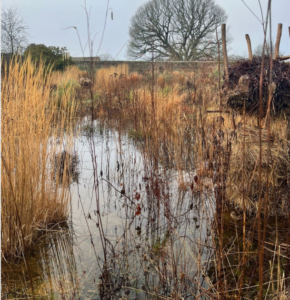
February: The Joys of the Ephemeral Pond
The year begins by plummeting us into a deep freeze – snow and ice lay over the country for a week, shadowed by biting arctic
 Skip to content
Home / January: the Wilding Gardens conference, the start of a movement

Moy Fierheller | Deputy Head Gardener
January: the Wilding Gardens conference, the start of a movement
Published February 2026
Visit Knepp’s rewilded Walled Garden
The year begins by plummeting us into a deep freeze – snow and ice lay over the country for a week, shadowed by biting arctic winds. The nonchalant power of nature dominates our lives and the landscape, reminding us in no uncertain terms who’s boss. But it’s also a call to listen; to stop. Our descriptions direct us – snap, freeze. We‘re given permission to rest and take a moment. To consider the coming year and resolve to hear what nature is telling us, where we need to step-up, when we need to stand back.
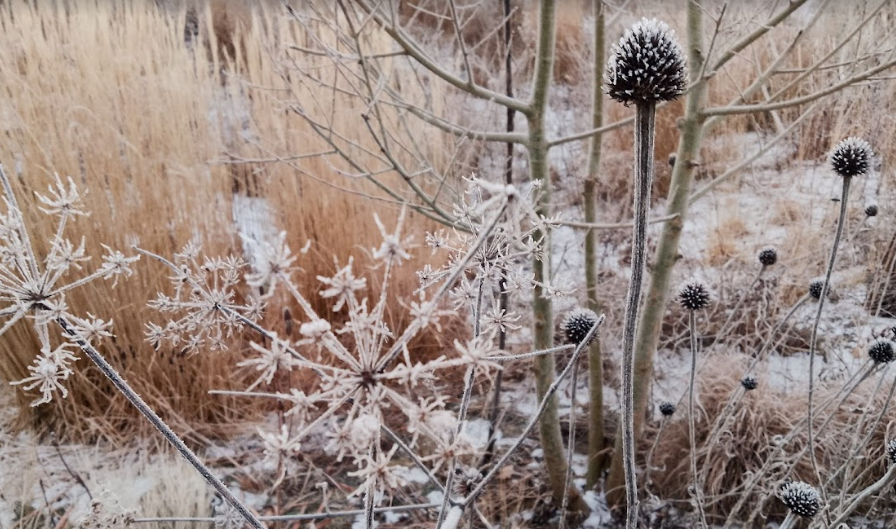
Despite the garden being suspended in -9°C crystalline perfection, the ground impenetrable as sheet metal and the ephemeral pond a lozenge of ice, it still holds the comfort of the faded yet familiar inhabitants. The tall grasses are tea-stained and rust coloured; warm cinnamon and coriander tints form the backdrop for the black, bone and silver sculptural standing stems and seedheads – moon carrot, coneflower, wild carrot (Sesili gummiferum, Echinacea paradoxa, Daucus carota).
We retreat to the office, pore over organic supplier’s lists, go in search of scribbled notes of plants we encountered and coveted last year, order veg and ornamental seeds for the coming season. Head Gardener Charlie Harpur busies himself with the final additions to his presentation for the inaugural Wilding Gardens Conference on 15 and 16 of the month – a conference that the whole Knepp gardening team travelled to Manchester to attend.
The idea for the conference was originally suggested by Adam Hunt, one half of the design company Urquhart & Hunt that won Best In Show at the Chelsea Flower Show in 2022 with ‘A Rewilding Britain Landscape’ based on a beaver dam. Adam brought the idea to his design partner Lulu Urquhart, Knepp’s owners Charlie Burrell and Isabella Tree, our Walled Garden’s designers Tom Stuart-Smith and Prof James Hitchmough, and our head gardener Charlie. With the help of conference producer Dudley Hinton, they planned a two-day summit of ideas to encourage rewilding practices in all forms of gardens. The ambition was to move the dial beyond ‘nature friendly’ gardening, shifting the conventional gardening aesthetic towards something looser, freer and more beneficial for wildlife, the climate and human health.
Over two days more than 400 people came together to the lecture theatre at Manchester University to listen to presentations from garden practitioners, designers, professors of ecology, biology and landscape architecture, educators, activists, conservationists, the Wildlife Trusts and the National Trust. The event culminated in a rousing speech from Andy Burnham, Mayor of Greater Manchester who set out his plans for a greener future for the city and everyday access to green space as a citizen’s right.
The contributions were full of insights, inspiration and information too dense to relate here (contributor’s details can be explored below in the Wilding Gardens link) but at Knepp we’re already thinking about how we might implement some of those ideas in our rewilded Walled Garden.
The ideas fell into broad categories: how to engage people with nature in a garden, the importance of the garden soundscape, wild landscape design, how to embrace the world of insects, the devastation caused by pesticides and herbicides, education, and gardening for climate change and sustainability.
In the same spirit as our garden experiment here at Knepp, underlying all these themes is the premise that every single garden, if gardened with nature at its heart, can make an important contribution to biodiversity. Collectively, all 23 million of them could help turn around the fortunes of British wildlife.
Craig Bennett, Chief Executive of the Wildlife Trusts, opened the conference by highlighting the importance of reconnecting people with nature; not just for the proven health and well-being benefits but to help build a groundswell for change in the climate and nature crisis. We wondered whether the experience of our own garden visitors initiates any change in thinking and practices, and how would we measure this? It’s not something we’ve considered – despite our hope that we’re contributing to nature recovery by communicating what we do and why and publishing our wildlife survey results. We’re keen to explore what our impact might be, and no doubt as AI becomes an increasing presence in information gathering and collation, we’ll be able to stitch together a picture of connections between ourselves and others around the UK and beyond.

AI was also mentioned in the immensely enjoyable presentation from Mike Edwards, a climate change advisor and sustainability consultant who opened his talk with an impressive didgeridoo performance. It illustrated his ideas on sound and resonance; how would it be to garden and design with our ears? Our concepts of beauty in gardens tend to be dominated by the visual, yet what garden is not improved by the sounds of thrumming bees, water, wind through grass, birdsong and countless other aural joys of the natural world? A silent garden is an indication that something is seriously wrong.
We immediately connected with Mike’s thoughts on sound surveying. With ecological soundscaping, soon AI will speed up the ability to identify and catalogue the species of a landscape through sound and, importantly, identify what is missing. This will likely reduce the cost of conventional survey work and create an accessible tool for use in garden spaces. We may try to capture sounds in the garden this year, if only in a very basic way – his ideas opened our ears!
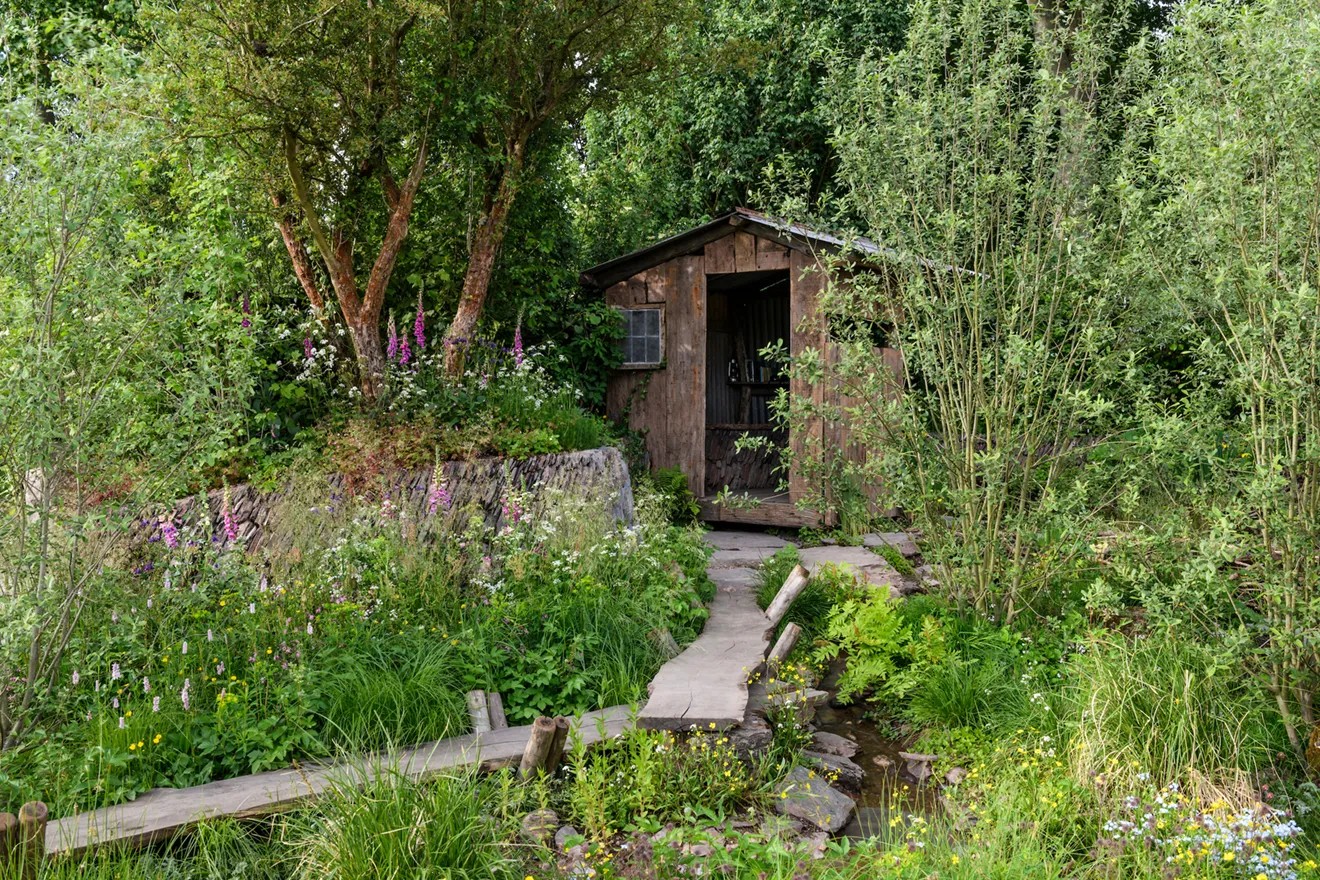
Lulu Urquhart described her astonishment at her and Adam’s first visit to a beaver site in Devon, which inspired their Chelsea-winning garden design. “The noise! Chaos, life, birds, insects!” she exclaimed, explaining that both of them realised with some force that they’d never known what a diverse landscape looked like until that moment. It kickstarted an idea for us to try and construct some beaver-lodge inspired insect habitat in the Kitchen Garden this year.
That noise and chaos that Lulu spoke of, that design based on the hum of wings, is all about insects and we were treated to some captivating content on them from Dr Erica McAlister. She’s an entomologist and Principal Curator at the Natural History Museum, known to most as the ‘Queen of Flies’. We’re incredibly lucky that she’s agreed to join our Garden Advisory Board. She’s also going to be leading several Incredible Garden Insect tours in the Walled Garden this year. Her knowledge can only be described as epic and her enthusiasm for her subjects, overlooked by most gardeners, is infectious.
After regaling us with some incredible facts and statistics (insects have been around for 480 million years; there are more fly species in the UK alone than there are mammals on the planet) she set us to thinking about the complexities of their life cycles, and the diverse habitats that are needed to facilitate those multiple stages of metamorphosis. Bugs are friends – essential and fascinating.
In the Walled Garden, we know that habitats like leaf litter, debris, old brick walls and wooden infrastructure, and providing damp and dry patches, shade and sunny spots, can help these complex creatures survive, and we’re eagerly looking forward to Erica’s knowledge taking us to the next level of understanding.
Sadly, pesticides are all too common in gardens, promoted by the £38 billion UK horticulture/garden centre trade, and introduced even unwittingly into gardens by pet owners, as Dave Goulson explained in his stark and revelatory talk. Best-selling author of Silent Earth and Professor of Biology at the University of Sussex, he has been involved in groundbreaking research on the catastrophic and far-reaching effects of pesticides. Anyone who’s visited a garden centre will have seen the aisle dedicated to the death of insects. Ironically, even plants labelled “bee-friendly” may have been grown using neonicotinoids, the most globally used insecticide, so when insects are attracted to the ‘bee-friendly’ pollen and nectar they are poisoned. Dog and cat flea treatments contain the deadly water-soluble chemical Imidacloprid that can contaminate you, your garden and the public water supply. Slug pellets contain Fipronil, a neurotoxin lethal to many insects.
There are many safe alternatives and practical actions that avoid the need for gardeners to use harmful chemicals and that should be promoted more widely. But most important of all, says Goulson, we need governments to act responsibly and ban the horticultural use of pesticides in gardens and communal green spaces. If Paris can go pesticide-free, why can’t London and Manchester? And not forgetting the Veterinary Association, that has a duty to enforce its own recommendation for veterinary practices not to promote the prophylactic use of pesticides for our pets.
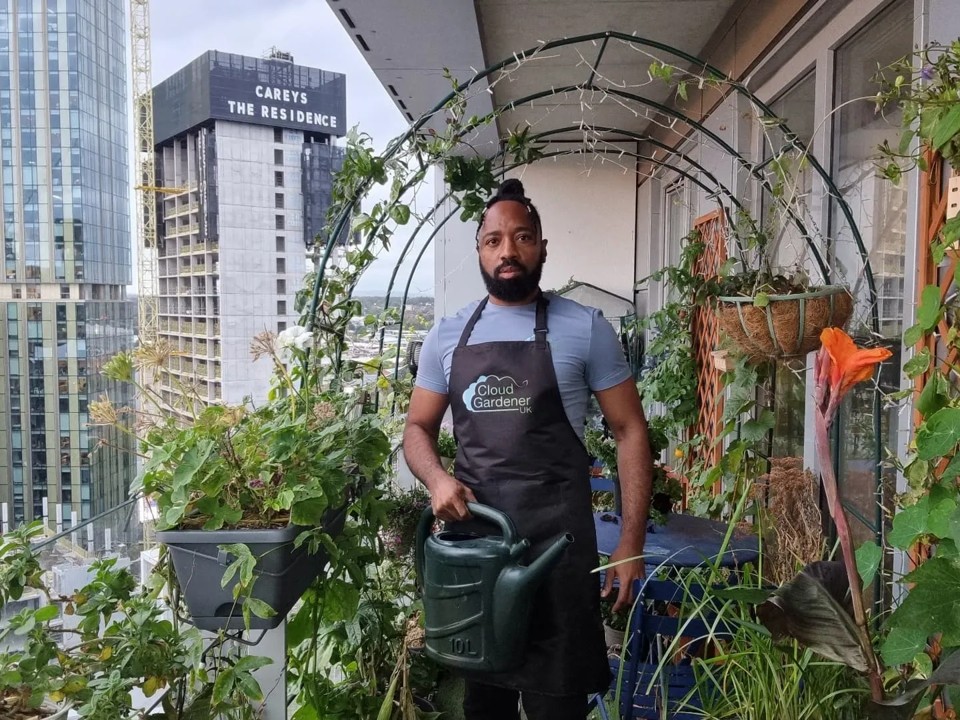
Ultimately, as many speakers recognised, it’s all about sharing knowledge: from Anna Gilchrist’s’ ambition to embed nature in the UK’s primary school curriculum (she’s Senior Lecturer in Environmental Management and Ecology at Manchester University), to wildlife landscaper John Little’s Care Not Capital, where his training programme for professional gardeners places them in public spaces where wildlife, sustainability and community engagement are prioritised, and the National Trust’s Head of Gardens and Parks, Sheila Das’ call to challenge the comfort and repetition of traditional horticultural practices but to “meet people where they are and be careful with our language”.
If all of us can embrace a little more wildness, in public parks, urban greenspace, allotments, community gardens, show gardens, housing developments, and our own window boxes, balconies and gardens, there’s hope for nature.
As our team member Joshua Chalmers brilliantly summarised in his conference field notes on social media: “The future landscape will not be tidy. It will be alive. It will be loud. It will be shared…. It is relearning how to live.”
Photos courtesy of Iris Tanner @tannerimagery, James Ingram.
Wilding Garden Tour – Knepp Estate, West Sussex A Garden of Incredible Insects with Erica McAlister
Wild Garden Tours – Knepp Estate, West Sussex
What we’re reading
Rewilding the RHS Chelsea Flower Show | Rewilding Britain
What is the impact of nature on human health? A scoping review of the literature – PMC
Gardens & Greenspaces | Weald to Waves
Dr Erica McAlister | Natural History Museum
Goulson,D, Silent Earth Vintage 2022 The Garden Jungle Vintage 2020
PAN UK Home – Pesticide Action Network UK
Care Not Capital | modern gardener training
The UK Rain Gardens Guide, managing water in our towns and cities
CyanLines – Where green and blue meet to grow the city…
Joshua Chalmers (1) Instagram
Garden Tips: February 2025
The year begins by plummeting us into a deep freeze – snow and ice lay over the country for a week, shadowed by biting arctic
We are looking for dynamic, enthusiastic and passionate Front of House staff with a passion for great service, produce and sustainability to join our growing

Isabella Tree catches up with two of the White Stork Project volunteers, Tim Morgan and Rosemary Dewan, as they prepare food for the non-flying storks
Knepp Wildland Safaris, our gardens and campsite are all about the quiet and patient observation of nature.
Some of the species we are likely to encounter are shy or can be frightened by loud noises or sudden movements. Our campsite with open-air fire-pits, wood-burning stoves and an on-site pond is unsuitable for small children.
For this reason, our safaris, garden visits, holiday cottages and campsite are suitable only for children of 12 and over.

You’ll receive relevant offers and news by email. This will include information about the Rewilding Project, online store products, the Wilding Kitchen Restaurant / Cafe, and other exciting experiences / events across the Knepp Castle Estate. For more information, view our Privacy Policy.