White storks and red kites – the battle for the skies over Knepp
It’s been about six centuries since white storks and red kites have encountered one another in the UK.
 Skip to content
Home / December: Garden Lessons

Moy Fierheller | Deputy Head Gardener
December: Garden Lessons
Published January 2026
Visit Knepp’s rewilded Walled Garden
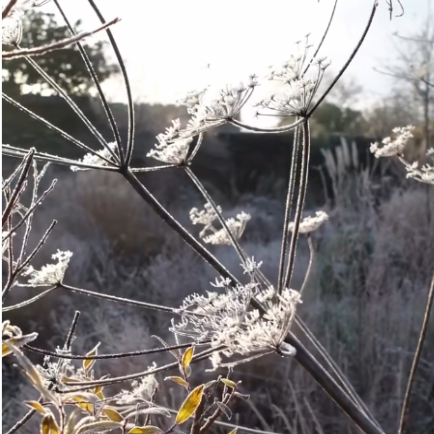
December is like a wavering bride-to-be, one moment all crystalline frost-white perfection, slowly transforming to a crisp, decisive, sunny sky; the next – despite a luminous, swollen full moon picking out silver linings on massing storm-clouds – raining copious tears amidst gusty squalls.
In consequence, the reshaping of the Kitchen Garden continues in fits and starts. We intersperse wheelbarrowing mushroom compost and loam to introduce some nutritious lumps and bumps into the beds with coppicing hazel and collecting suitable poles for making hurdles and plant supports for next year. Planting up pots filled with spring bulbs like narcissus, grape hyacinths and species tulips to brighten the grey-sky months indoors fill the worst of the deluge days, as well as creating a detailed plan for the new season’s vegetable crops.
It‘s been another incredibly busy year – we hosted 147 workshops and garden tours with just under three thousand visitors, introduced fifty new plant species into the garden, made and laid tons of compost, grew and harvested a plethora of vegetables, replenished the soil, browsed our woody plants, sowed, grew and planted seeds. We were hugely grateful for the help of Knepp volunteers who trampled and hoed paths with us, created climbing plant structures, and pruned and harvested in the orchard. We hosted fifteen garden students this year, sharing our knowledge and experience with them.
We’ve been reflecting on our own take-aways – what the garden has taught us this year.
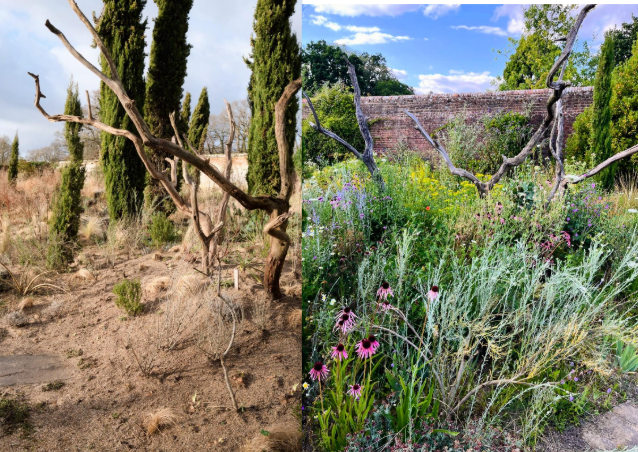
The highlight for Charlie Harpur, our Head Gardener, came when he was working in a particular section of the rewilded part of the garden on a warm September day. This area had suffered from historical compaction and was further impacted by the garden redesign in 2021. Instead of trying to de-compact the heavy Wealden clay beneath, last winter we had simply introduced a sizeable mound of loam and recycled sharp sand on the top to see what would happen. We know that varying the topography can add to a garden ecosystem in all sorts of ways – giving distinct aspects like sunny and shady sides which in turn create different microclimates. Mounds also tend to cope better with extremes of wet or heat, and the introduced soil or substrate can be intentionally different to the underlying topsoil, providing another variation to boost the diversity of plants. Most importantly, sloping sunny sides tend to favour insects – they warm up and retain heat for longer than on flat ground – and are more free draining, less prone to being damp, making perfect microhabitats for nesting and basking.
The mound had been built up with a long bank of loam made from the lawn turf we took up in 2021, roughly 200cm long by 40cm high, incorporating three upright stag-oak limbs and was topped with recycled sharp sand to varying depths between 10 and 30cm.
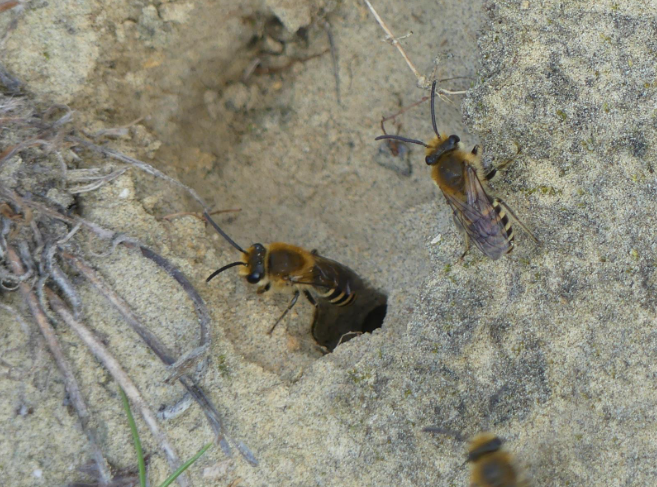
On that sunny autumn day when Charlie was ‘editing’ the mound (ie. reducing the number of plants to keep bare patches open) he noticed a busy assemblage of solitary ivy bees (Colletes hederae). They had pockmarked the sunlit slopes with small nest holes, and their frantic mating activity, in and out and around these apertures, made the mound a buzzing blur of life.
Charlie was amazed at how little time had elapsed between the building of the mounds and the arrival of the bees. We have plenty of ivy around and over the walls of the garden and we’ve previously noted them on the plant itself but we’ve never seen nests in the crushed concrete and sand mixes that we landscaped in 2021.
A rare and genuine case of “If you build it, they will come.”
Ivy bees were first recorded in Dorset around 2001, and although they’re non-native, their emergence in late August, early September when most other solitary bees have finished their life cycles mean they’ve presented no threat to native populations. They look similar to honeybees but sport a yellowy-orange tuft on their heads, and feed predominantly on the nectar and pollen of the wonderful yellow-green umbel flowers of ivy (Hedera helix), that resemble a suspended star-burst firework. The bees use their own saliva to strengthen their nest tunnels, so presumably the sharp sand we’ve used has a favourable particle size to bind into a solid structure.
They also provide an opportunity for a larval parasite – that of the blister beetle (Stenoria analis). A study found that newly hatched larvae mimic the odour of female ivy bees and attach themselves to the males who then afford them safe passage into the nest and the nectar and eggs that lie within.
Josh Chalmers, who curates the garden at the Wilding Kitchen & Shop, as well as working here in the Walled Garden, was on the receiving end of a very different epiphany to do with our use of aggregates.
Late last year we made the decision to cut up the Kitchen Garden pie and allocate areas between us to help manage this edible landscape in more detail. Part of Josh’s lot were two beds that underwent a transformation when Tom Stuart-Smiths turned them from lawn into beds in his redesign of 2020. They were planted with unusual and common edibles like giant fennel (Ferula communis), Sichuan pepper (Zanthoxylum simulans), artichokes (Cynara cardunculus), and sea buckthorn (Hippophae rhamnoides) together with herbs like marjoram, catmint and lavender. Since all these plants hail from free-draining habitats, the existing topsoil was mixed with six cubic metres of horticultural grit, using a mini-digger.
Josh had spent a lot of time in these beds and he noticed all the competitive species that readily colonise waste or disturbed ground such as ox-eye daisies and oregano were thriving, even after heavy editing, and the woody species and any annual vegetable additions struggled to put on growth. On investigating, he found that soil organisms had failed to incorporate the grit, and large accumulations had coalesced and were devoid of organic matter and life. The intention was to increase aeration and improve drainage, but it seemed that insufficient mixing – perhaps the ratio of grit to topsoil being too high – had led to a lack of water-holding capacity in the soil, making it unavailable to plant roots.
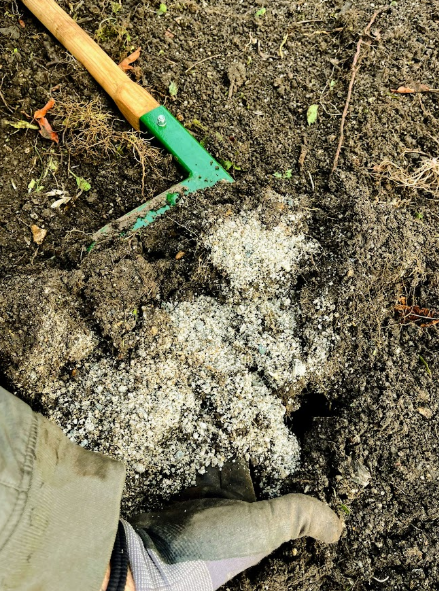
When we addressed the situation by re-setting the beds – digging up the plants, breaking up compaction with a broad fork, adding in loam and mushroom compost, and thoroughly mixing and re-planting in mounded, concentric bands of beds – Josh felt a sense of collaboration with the garden, and learning through doing. We communicate the ideas of changing topography and growing mediums with our visitors but to experience our design ideas in the physical world, to analyse a substrate or soil, and plant in free-draining mounds and see how plants respond is a gratifying insight, far from traditional horticultural teaching.
Suzi Turner, my fellow Deputy Head Gardener and head of edibles, felt her most important lessons had been learnt during the three heat waves the garden experienced this year. The Kitchen Garden showed some resilience in June’s high temperatures, the exuberance of spring growth and dense planting going some way to mitigate moisture loss and keep up humidity around the plants. By late July hosepipe bans were in place across parts of Sussex. The soil in the perennial vegetable beds was dry and lifeless. When the rains finally arrived in September Suzi observed that where we had made leaf-mould mounds to introduce and preserve soil organisms, and laid down sheep’s wool around new plantings, the soil bounced back. There were worms and other larger soil dwellers, and the moisture was being held. For Suzi, it was this process of analytical observation, experimentation and positive responses that she appreciated most.
My delight came from a small thing, that could be called ‘The Vindication of Patience.’ When we’re editing the garden, rather than taking dead material out of the ecosystem, we try and incorporate it into the landscape in a deliberate way, with an aesthetic sensitivity that will also create new habitats and opportunities for biodiversity. Two seasons ago, I had wedged a section of dead wood not more than ten centimetres long behind a climbing wire against the red brick wall. When the leaves of the surrounding clematis fell this autumn, it revealed how natural processes had been at work to create a miniature eco-system – small rafts of bracket fungus had taken up residence. Moss had carpeted the upper side which hosted fallen leaves and stems. A tiny seedling was beginning its life in this sheltered haven.
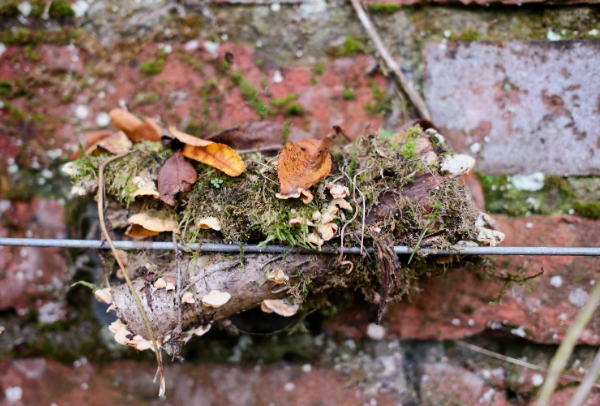
Eventually, it will break apart and crumble, fall to the ground and be consumed by the soil. In nature, as in life, the end of one thing is only the beginning of another.
Photos courtesy of Benny Hawksbee, Charlie Harpur
What we’re reading
https://cdn.buglife.org.uk/2019/07/Managing-Aggregates-Sites-for-Invertebrates.pdf
https://www.sciencedirect.com/science/article/abs/pii/S0140196302002811
Benny Hawksbee (@bennyhawksbee) • Instagram photos and videos
ttps://www.researchgate.net/publication/236210966_Larval_aggregations_of_the_blister_beetle_Stenoria_analis_Schaum_Coleoptera_Meloidae_sexually_deceive_patrolling_males_of_their_host_the_solitary_bee_Colletes_hederae_Schmidt_Westrich_Hymenoptera_Coll
Garden Tips: January 2025
It’s been about six centuries since white storks and red kites have encountered one another in the UK.
The year begins by plummeting us into a deep freeze – snow and ice lay over the country for a week, shadowed by biting arctic
We are looking for dynamic, enthusiastic and passionate Front of House staff with a passion for great service, produce and sustainability to join our growing
Knepp Wildland Safaris, our gardens and campsite are all about the quiet and patient observation of nature.
Some of the species we are likely to encounter are shy or can be frightened by loud noises or sudden movements. Our campsite with open-air fire-pits, wood-burning stoves and an on-site pond is unsuitable for small children.
For this reason, our safaris, garden visits, holiday cottages and campsite are suitable only for children of 12 and over.

You’ll receive relevant offers and news by email. This will include information about the Rewilding Project, online store products, the Wilding Kitchen Restaurant / Cafe, and other exciting experiences / events across the Knepp Castle Estate. For more information, view our Privacy Policy.