White storks and red kites – the battle for the skies over Knepp
It’s been about six centuries since white storks and red kites have encountered one another in the UK.
 Skip to content
Home / November: The Kitchen Garden – a New Approach

Moy Fierheller | Deputy Head Gardener
Published December 2025
Visit Knepp’s rewilded Walled Garden
November begins with warmth and rain. The remnants of Hurricane Melissa that caused tragedy and catastrophic damage in Jamaica and produced the highest ever recorded wind gust at 252mph, mercifully brought us only a weakened front of buffeting winds. The stands of feathery cream plumes of Chinese silver grass (Miscanthus sinensis ‘Flamingo’) in the garden sway in rhythmic bursts, and the spiralling, leaping dance of burnished falling leaves commences, revealing dark moss and lichen-tinged tree limbs.
Fallen leaves play an important role in any ecosystem. Over millions of years, countless soil organisms evolved alongside leaf litter – they form the basis of the natural food web. Fungi and bacteria, as well as larger soil-dwellers like worms, feed on the dead material, slowly returning organic matter to the soil, increasing porosity, allowing air and water to move freely, roots to penetrate the surface and providing ideal germinating conditions for seeds. The stable moist environment creates winter habitat for insects, egg laying and larval development as well as insulation and camouflage for pupae, bumble bee nests and frogs and toads. Birds and small mammals forage in leaf litter and use the material for nesting in spring, while a covering of leaves in hot summers can prevent soils from drying out.
The desire to ‘clean’ areas and remove leaves is a relatively recent human pursuit, particularly in gardens where aesthetic considerations tend to take precedence. Of course, pathways and hard standing can become slippery and potentially dangerous if leaves are left to break down, and some plants can rot off under winter cover – usually those that thrive in hot, dry habitats.
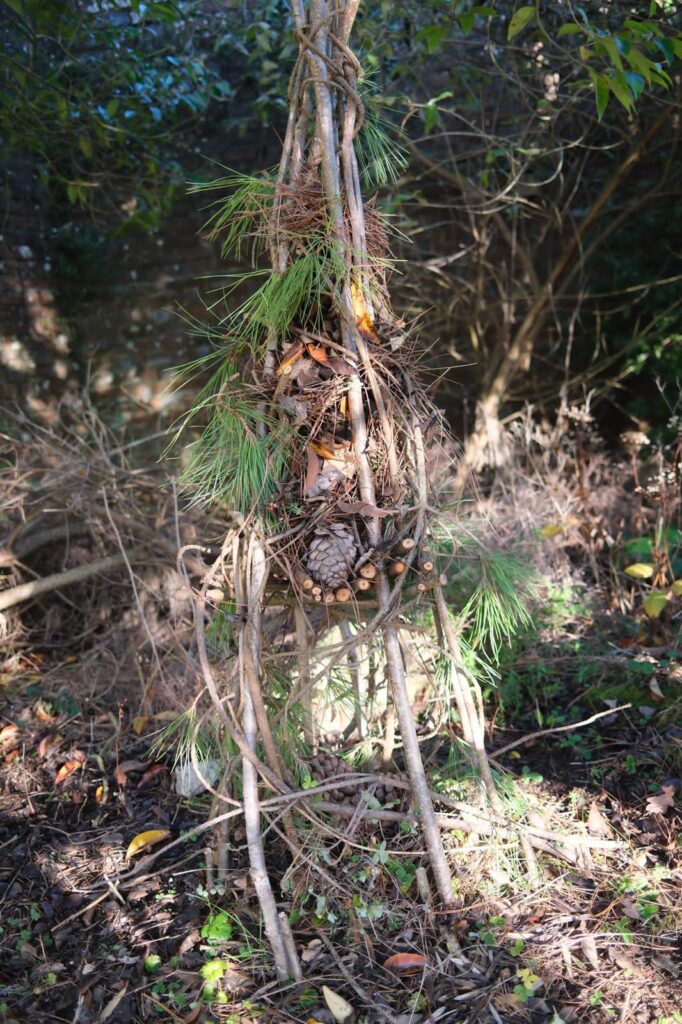
In the garden, we try to take a mixed approach. We either hand rake or use an electric blower – petrol or diesel blowers are awful greenhouse gas emitters as they lack catalytic converters and exude a cocktail of harmful air pollutants into the bargain. The crushed concrete and sand blend in the Rewilded Garden supports a plant community that thrives on low nutrients, so most fallen leaves we collect and use in habitat ‘stacks’ – mixes of grasses, stems and leaves contained within upright hazel poles – or add them to our leaf mould pile which we use to improve the soil structure of the vegetable beds once it’s rotted down over the year. In the Kitchen Garden, we might move leaf litter nearer the back of beds close to the walls, where drier soil sits in a rain shadow or under woody plants, being careful to allow air flow around the base of trunks, and not overlaying with so many leaves that roots are deprived of air. We also use small piles as frost protection for half-hardy perennials, using willow or hazel whips to stop them being blown away.
By mid-month, after weeks of confusingly warm temperatures of 14 to 16°C, the first cold snap arrives. It’s not good timing. We have big plans to re-shape the Kitchen Garden and this now has to pause, while the garden is frozen hard in icing sugar-coated winter beauty, and fat flakes of snow the size of fifty pence pieces fall in slow mesmerising sheets.
What has prompted our re-thinking on the Kitchen Garden?
We need to go back to the beginning, to the start of this garden experiment designed by Tom Stuart Smith and Professor James Hitchmough in 2020 and how it’s developed since then. The overall ambition behind the garden’s design is, in Tom’s words, to unleash a ‘host of unpredictabilities’, where the creation of complex wildlife habitats would be both beautiful and support biodiversity. The Kitchen Garden was envisaged as a space in which to grow plants as food or medicines, retaining the existing path edges and topography, but adjusting the paths to support xeric herbs – those that prefer dry habitats – and increasing the range of annual and perennial edible plants throughout, that are equally useful for people and wildlife.
Since the landscaping and planting in 2020/21 our management has been on a gradient between traditional principles of organic annual vegetable growing and rewilding – allowing natural processes of disturbance, mimicking the actions of herbivores and other landscape engineers like the Tamworth pigs at Knepp, increasing or reducing stress to dictate how the plant communities behave and letting self-seeders and volunteer plants proliferate for the benefit of wildlife.
But all this rests on the health of the soil, which is really about the amount of life and biodiversity within it. What we’ve found through observation, surveying and soil testing is that, despite some remedial work in certain areas, the soil in the Kitchen Garden needs some help to become a more productive growing medium. We think it has never quite recovered from historical compaction and the removal of topsoil during the years when it was used to grow plants in raised sand beds for the wholesale commercial market. Once, the whole of the Walled Garden would have had wonderful rich soil, created over a hundred years of old-fashioned composting and vegetable gardening by a team of Victorian gardeners. All this was lost when the Estate was facing huge financial losses under farming in the 1980s, and converting the Walled Garden to a nursery garden business was another way the Burrells attempted to bring in additional income. The nursery business worked for about a decade but then, when it was leased to an external company, it collapsed and the garden was left abandoned until Charlie and Isabella decided to return it to a family garden in the 1990s.
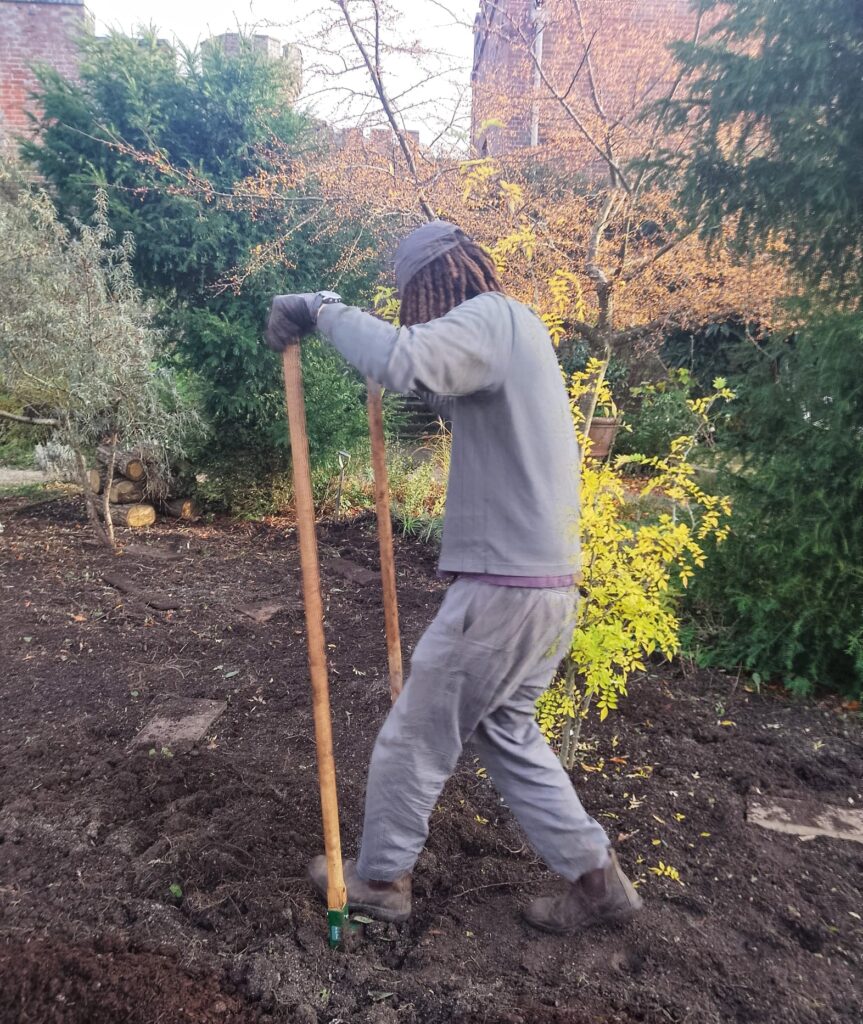
We begin the re-shape with five of the thirteen beds, taking out the existing plants and thinning out species that have become dominant – ox-eye daisies, wild strawberries and wild marjoram. With a broad fork (a huge garden fork that you can stand on), we break up the compaction beneath the top layer, then add a combination of loam – we’re using the original turf we removed from some of the croquet lawn and pathways that has broken down over four years – and mushroom compost, replanting the majority of the currant bushes, artichokes, bergamot, honey berry, fruit trees, and other perennial edibles we’ve dug up.
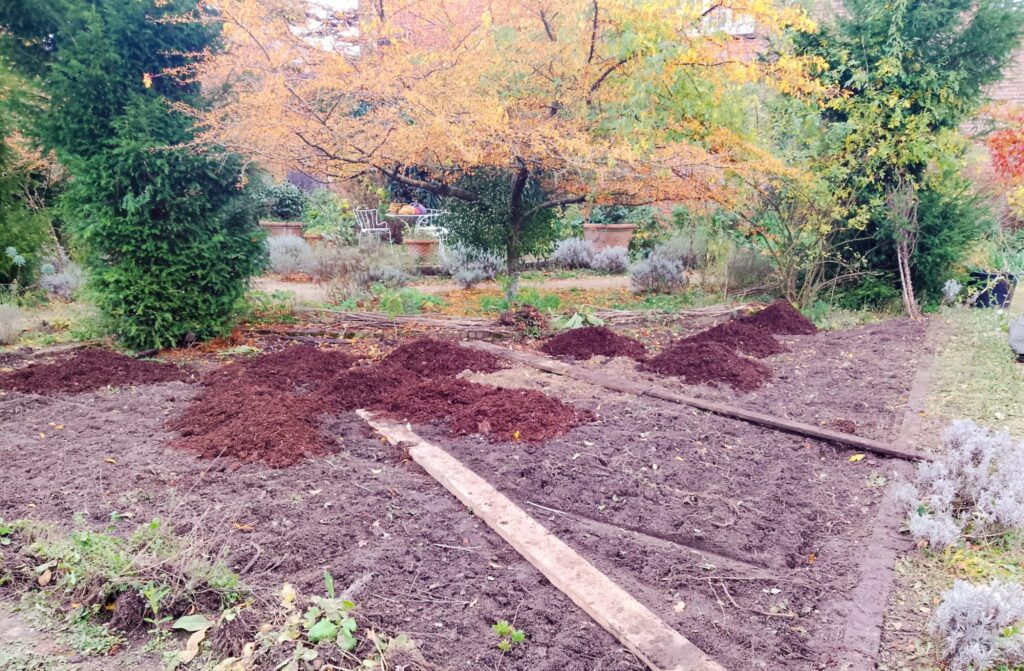
We’re going to divide the garden into three different growing systems – a high-yield annual cropping section, producing vegetables such as peas, beans, asparagus and root crops; agroforestry or forest garden beds; and beds based on elements of syntropic farming, growing a diversity of plants in succession, and generating abundant biomass, using pruning’s to return nutrients to the soil in situ.
We’ve seen from the Rewilded Garden how changing the topography can benefit plants and increase habitats, so some of the beds have been mounded in several different ways. The mounding in forest gardening mimics a woodland edge, increases the surface area of the space and allows for layers of edibles from woody plants to leafy vegetable and herbs. We make a series of concentric mounds divided by narrow wood chip paths to make harvesting easier. The slopes aid drainage in wet years and in drier seasons. An irrigation channel can be made at the base of the mounds to keep roots watered less wastefully than overhead sprinkling. In other beds we make some more irregular mounds of different shapes and sizes, creating a deeper layer of improved soil for roots to penetrate, with sunny warm ridges and shady north-facing sides for leafy vegetables. We give the flatter areas a generous layer of loam and compost.
Essentially, this section of the Walled Garden will be guided by principles of regenerative farming, food production being the primary focus, with benefits to nature as a by-product, in much the same way as Knepp’s organic Market Garden. These principles are all about speeding up natural processes and intensive, selective disturbance – cutting back, moving plants, removing competitive species, and encouraging slower-growing edible plants with additional resources like water and natural fertilisers. Here, fertility and biodiversity in the soil will be our main focus. This is a different mindset to the approach we have in the other half of the garden – the Rewilded Garden – where wildlife habitat and biodiversity is our primary goal and our efforts are to reduce soil fertility to encourage resilient wildflowers and plants that love poor conditions.
Regenerative agriculture works to support the regeneration of soil health and increasing soil biodiversity to produce high yields of nutritious food, without the use of herbicides and pesticides that have characterised the majority of farming practices in the last 50 years. It includes minimal disturbance of the soil – known as ‘low till’ or ‘no-till’ (ie no or minimal ploughing or digging), a rotational diversity of crops, keeping living roots in the soil, protecting the soil surface protected with cover crops, and integrating animals to tread crops into the soil to enrich it and fertilise the area naturally with their dung and urine. Naturally, in the Walled Garden we won’t have livestock – we’re using the manure-rich winter bedding of the herd of Sussex reds on Knepp’s regenerative farm to mix with our home-made compost.

Ultimately, rising temperatures dictate to all of us that we need more resilient, sustainable and healthier growing systems across the board – from our gardens and allotments through to large-scale farming. COP30 delegates (minus the US, one of the world’s biggest emitters of greenhouse gases), gathered this month in the Brazilian rain forest, tying up the last of the negotiations of the Paris Climate Agreement. The next steps will be for individual countries to decide their own pathways to a reduction in global warming. As one commentator said when questioned about whether the annual COP meetings make a difference, she replied: “ It’s always better to be talking than not talking”. Communicating our successes and failures, swapping stories and sharing what we grow must be the way to help us move into the future with hope and purpose.
Photos courtesy of Joshua Chalmers, Charlie Harpur, Moy Fierheller.
What we’re reading;
Principles of Regenerative Agriculture – Groundswell Groundswell
What is Syntropic Farming? – Agenda Gotsch
Fukuoka, M, The One Straw Revolution Rodale Press 1978
UN Climate Change Conference – Belém, November 2025 | UNFCCC
Rare Earth – COP30: A New Hope? – BBC Sounds
The Food Programme – And the Winner Is… The BBC Food And Farming Awards 2025 – BBC Sounds
New GB Red List for Vascular Plants
Garden Tips – December 2025
It’s been about six centuries since white storks and red kites have encountered one another in the UK.
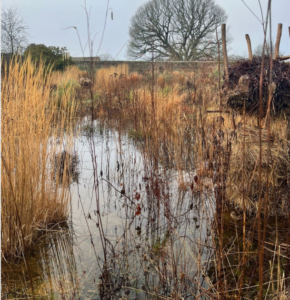
The year begins by plummeting us into a deep freeze – snow and ice lay over the country for a week, shadowed by biting arctic
We are looking for dynamic, enthusiastic and passionate Front of House staff with a passion for great service, produce and sustainability to join our growing
Knepp Wildland Safaris, our gardens and campsite are all about the quiet and patient observation of nature.
Some of the species we are likely to encounter are shy or can be frightened by loud noises or sudden movements. Our campsite with open-air fire-pits, wood-burning stoves and an on-site pond is unsuitable for small children.
For this reason, our safaris, garden visits, holiday cottages and campsite are suitable only for children of 12 and over.

You’ll receive relevant offers and news by email. This will include information about the Rewilding Project, online store products, the Wilding Kitchen Restaurant / Cafe, and other exciting experiences / events across the Knepp Castle Estate. For more information, view our Privacy Policy.