Bring back the bison – a new animal for Knepp?
It’s been about six centuries since white storks and red kites have encountered one another in the UK.
 Skip to content
Home / March: Bug hotels v natural shelter – finding the balance

Moy Fierheller | Deputy Head Gardener
March: Bug hotels v natural shelter – finding the balance
Published April 2026
Visit Knepp’s rewilded Walled Garden
The clock and the heartbeat of spring begin to tick and beat a little faster every day. The earth pushes forth urgent, vivid green shoots; the white and pink of cherry blossom moves from bud to petal in under a week. Tiny T-shaped seedling leaves sit on impossibly thin stems, as unsteady and magical as a newborn foal, steadily burgeoning. A week of longed-for blue sky brings a honey-gold light that throws everything in its path into sharp relief.
The garden, still in a slightly bedraggled state from the relentless winter rain, begins to wake up. Thick fleshy leaves of Leichtlin’s camass and quamash (Camassia leichtlenii ‘Caerulea’ and Camassia quamash) shoulder their way through the layer of sharp sand in the drying edges of the ephemeral pond, despite their bulbs having been submerged under a foot of water for the last three months. They’re North American perennials in the asparagus family – the bulbs have been a slow-roasted food for Native Americans for thousands of years – and they’re found in moist meadow habitats. The lavender-blue flower spires will be romping all through this part of the Rewilded Garden by late spring. As these and many other perennial plants emerge from their winter dormancy, it’s an annual source of wonder and relief that they ‘ve survived: a comforting feeling that the cycle of the seasons is turning. The returning raucous cries of mallard ducks, finding safety for nesting within the walls of the garden, a flit of yellow from the wings of a brimstone butterfly, the drone of a queen buff-tailed bumblebee among the carpet of primroses in the Kitchen Garden.
We’ve been slowly moving through the landscape cutting back and collecting dead material – sustaining complexity and diversity of habitats by leaving some standing, removing some, holding on to some. We’re using this material in three new habitat stacks, adding to the four we built in the Rewilded Garden last year.
We’re often asked how our horticultural minds have changed since working here and, certainly, we were never taught or encouraged to think about the importance of structure – walls, posts, gates, as well as plants of varying heights and densities – and voids – as habitat for wildlife. All living creatures are in search of a refuge: somewhere to shelter, to hide from danger, to store food, to lay eggs or give birth, to raise or leave their young in safety. Structure provides a solid base, walls or tunnels of diverse heights, dimensions and materials, from moist to dry, upright to horizontal, temporary or long standing. Voids are spaces -‘Goldilocks’ niches that aren’t too big or small, but just the right temperature, in just the right place at just the right time.
A garden – by its very nature bordered by walls, fences or hedges – most likely already contains an abundance of physical structures. Add climbing plants, trees and shrubs, grasses, and carpets of perennials, bulbous and annual plants, and every layer presents more habitats.
It becomes difficult not to see voids of all sizes wherever we look in the Walled Garden – within the crushed concrete and tiny particles of sharp sand, amongst the log piles, under bark, in the lime mortar of the garden walls, and amongst all the dead material gardeners traditionally burn or throw onto the compost. Each space is potentially prime real estate for insects, birds and small mammals.
Our habitat stacks are essentially four upright hazel posts with crossed horizontal support poles. We fill them with dead stems, grasses, twigs, small logs and bark we’ve collected. This year we’ve left empty space between the ground and the first horizontal as we’ve found that last year’s grassy stacks have increased our vole population. We like voles, we just don’t want too many!
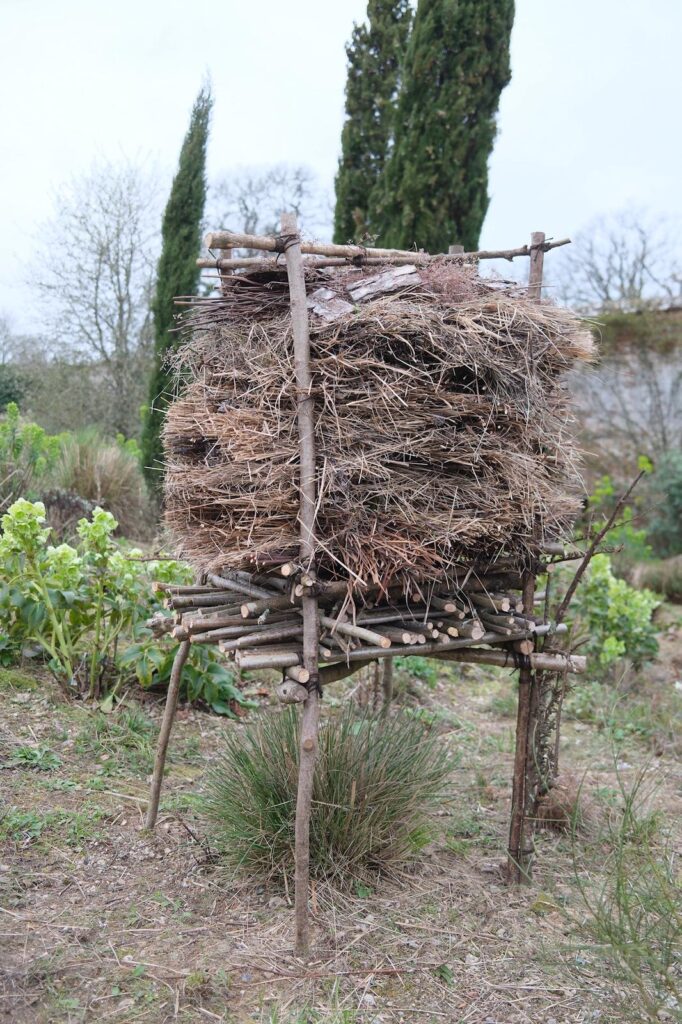
There are several reasons why we make these stacks, the obvious one being that we’re adding another type of habitat, but also as a ‘cue to care’. We’re signalling to visitors that leaving dead material in the space is intentional and that ‘messiness’ (a perennial rewilding put-down) can be curated to look pleasingly textured and architectural. The two metre stacks are also adding a missing layer of height to this young garden, only in its fifth season; the planted trees are still in their youth and there’s a gap between older existing trees and the shrub layer. High, bare branches are perfect jumping-off perches for songbirds and warm sunny spots for dragonflies.
We’ve also cleaned out and refilled two ‘insect hotels’ – large structures made with boarded wooden sides filled with clusters of hollow bamboo tubes, roof tiles, and logs drilled with holes. The spring clean is prompted by a visit from the fantastic Erica McAlister. She’s an entomologist, author, presenter and Principal Curator at the Natural History Museum in London. We’re thrilled she’s going to be leading a series of insect tours in the garden this year. Her views on insect hotels, particularly commercially produced ones, are not favourable. As is so often the case with these things the devil is in the detail.
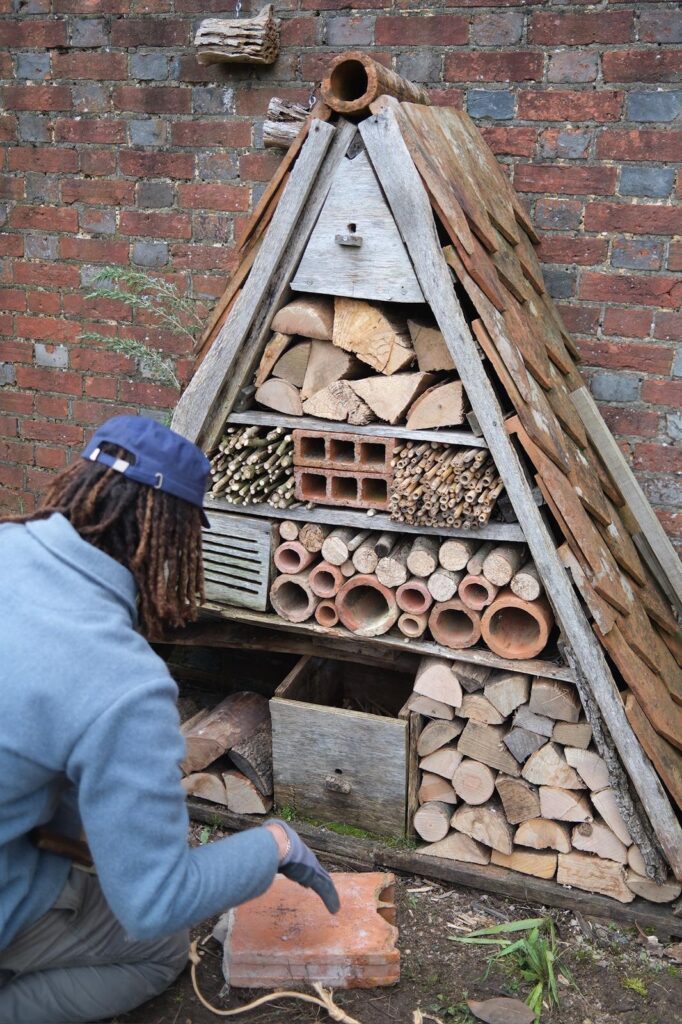
In Finland, a government ministry launched a nationwide campaign called Insect Hotels 2020. Its main aim was to raise awareness about the decline of insects and encourage people to build nesting sites. Without doubt, both are important, particularly in urban areas where gardens form corridors between larger green spaces, and that’s why we have bug hotels in the garden, as examples of what can be done if space is a limiting factor.
But, as Erica points out, there are some important things to bear in mind. Generally, DIY kits and manufactured bug hotels bundle together plant ‘stems’ made from bamboo or plastic and holes drilled in wood in a very artificial way. A 2015 study found that the tunnels in all the examples of commercially available bug hotels they tested were in greater density than are generally available in nature. Cavity-nesting bees, for example, use pithy stems or holes made by beetles and these tend to be spaced further apart in the wild. Just as overcrowding in human habitation can contribute to an increase in the spread of diseases and parasites, so, too, in a bug hotel. Plastic tubes used in bug hotels are not porous like most natural materials that can ‘breathe’, so condensation can often build up. Moist environments or rotting material are more likely to host harmful bacteria, viruses and fungal pathogens.
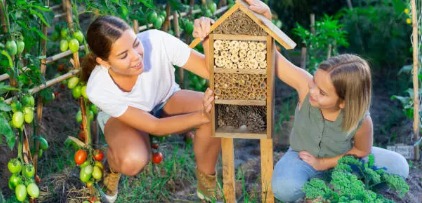
Providing numerous cavities in unnatural proximity can also tip the balance in favour of insect predators. Insects such as parasitic wasps lay their eggs in the larval cells or tubes made by bees and, when the wasp eggs hatch, the wasp larvae eat both the stored pollen intended for the emerging bee, and the bee larvae. Of course, everyone has to make a living, even the parasites. There are over 6000 species of parasitic wasps in the UK and they’re important biological pest controllers. But by artificially increasing habitat density we may be favouring species that predate on the very things we’re hoping to help, including those insects, such as mining and solitary bees, that are declining because human behaviour has destroyed their habitats in the first place.
Let’s not throw the baby out with the bath water. The details are important. Have a bug hotel, but not too big. If it’s a larger collection of different habitats, make sure it’s stocked up with new material and anything that’s mouldy, rotten or damp taken out. Replace hollow stems every year in late summer to reduce parasites and prevent disease. Welcome your community. Websites like Bees, Wasps and Ant Recording Society (BWARS) and Buglife have information on species that are most common in your area. Buglife has a dedicated page for Important Invertebrate Areas (IIA’s) – places that support rare and threatened species (see below for links). Knowing your local insect species gives you an idea of the diameter of hollow stems you’ll want to provide to attract them. Most cavity nesting bees, such as leafcutter and mason species, need apertures between 2 and 10mm wide and tubes around15cm in length, with a sealed end.
For us in the Rewilded Walled Garden, it’s a continuous learning curve – an experiment in building dynamic habitats layer by layer, trying to observe and mimic natural processes.
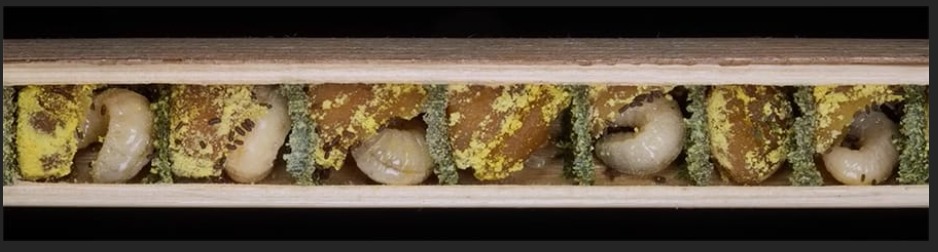
Much of our inspiration for providing structure and voids as insect habitat comes from brownfield sites and abandoned buildings – some of the most biodiverse places in the UK. Appreciating the cracked and broken elements in a garden – the tumble-down, the holey, the random pile, the boggy bit, the old tree stump and fallen limb is an art. Sometimes the best way to support nature recovery is a change in our frame of mind.
Photos courtesy of Charlie Harpur, Moy Fierheller.
What we’re reading:
‘Bee Hotels’ as Tools for Native Pollinator Conservation: A Premature Verdict? | PLOS One
How pests and disease affect bee pollinators16540 LWEC P&P Note 17_v
Bees Wasps & Ants Recording Society | BWARS
Notes on the use of ‘bee hotels’ by stemnesting Hymenoptera in three County Dublin orchards on JSTOR
Welcome to the UK Pollinator Monitoring Scheme (PoMS) | PoMS
Garden Tips: April 2026
It’s been about six centuries since white storks and red kites have encountered one another in the UK.
It’s been about six centuries since white storks and red kites have encountered one another in the UK.
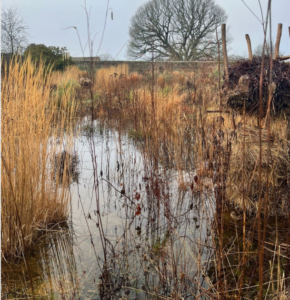
The year begins by plummeting us into a deep freeze – snow and ice lay over the country for a week, shadowed by biting arctic
Knepp Wildland Safaris, our gardens and campsite are all about the quiet and patient observation of nature.
Some of the species we are likely to encounter are shy or can be frightened by loud noises or sudden movements. Our campsite with open-air fire-pits, wood-burning stoves and an on-site pond is unsuitable for small children.
For this reason, our safaris, garden visits, holiday cottages and campsite are suitable only for children of 12 and over.

You’ll receive relevant offers and news by email. This will include information about the Rewilding Project, online store products, the Wilding Kitchen Restaurant / Cafe, and other exciting experiences / events across the Knepp Castle Estate. For more information, view our Privacy Policy.