
White storks and red kites – the battle for the skies over Knepp
It’s been about six centuries since white storks and red kites have encountered one another in the UK.
 Skip to content
Home / February: The Joys of the Ephemeral Pond

Moy Fierheller | Deputy Head Gardener
February: The Joys of the Ephemeral Pond
Published March 2026
Visit Knepp’s rewilded Walled Garden
After the three named storms that raged across the UK in January like vengeful fiends, the turbulent mood continues into February. Battleship-grey skies look down on shadowless, skeletal winter trees and rain is our constant companion.
The flares of colours and scents in the garden are all the more welcome – crocus and snowdrop, netted iris, Nepalese paper plant, and Lenten roses (Crocus etruscus, Galanthus nivalis, Iris reticulata, Daphne bholua, Helleborus x hybridus). The dabs of lilac, pure white, deep midnight blue, ruby red and blush pink are like sunshine amongst the canvas of tonal browns and faded greens of the winter-sleeping plants.
The ‘volunteer’ plants that arrived in the garden of their own accord are adding their own flavours to the mix. The heavenly scent of the canary-yellow gorse flowers (Ulex europaeus) drifts through the garden, a beacon for bees when the rain breaks, and the tiny, pretty, white flowers of hairy bittercress (Cardamine hirsuta) are welcoming any short-tongued, early emerging insects. They’re both edible, too – the flowers of gorse can brighten a salad, to which the peppery young leaves of bittercress can be added.
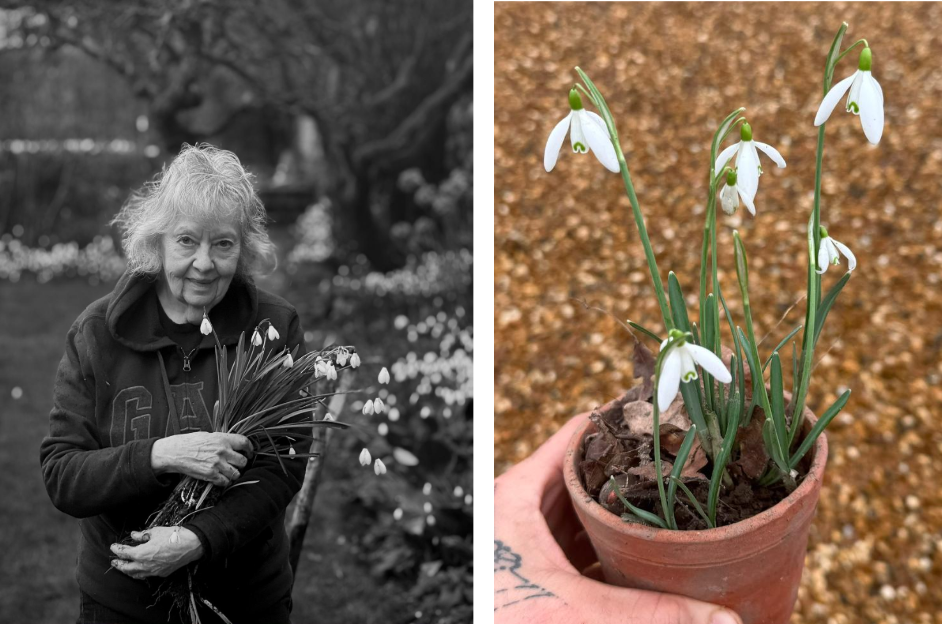
We were lucky enough to gain some beautiful additions to our two species of snowdrops when Josh, one of our garden team, visited Hyde End in Gloucestershire. Hyde was the home of The Giant Snowdrop Company that democratised snowdrops in the 1950’s and 60’s by propagating and selling the plants by mail order – previously rare varieties were made available for the first time to everyday gardeners. Josh and Frances Kaupe, who has taken over the care of some of the collection, swapped some of our Galanthus nivalis for her Galanthus ‘S. Arnott’. The latter is produced from the hybridisation of G. nivalis and G. plicatus. Samuel Arnott first discovered the hybrid in his garden and cultivated it. He was a snowdrop obsessive – or ‘galanthophile’ – back in the 1800’s; one of many that still persist today, fascinated by the subtle range and diversity of the flower shapes and markings. They give these petal marks fantastic descriptive names such as ‘sad face, scissors, chromosomes and boxer shorts’. Rare specimens can sell for as much as £500 a bulb. They’re native to the Caucasus Mountains and Western Asia, named from the Greek for milk (gala) and flower (anthos) and are amongst the earliest flowering bulbs in the UK. ‘S. Arnott’ – the variety we’re delighted to have acquired – is long-stemmed with large, white, honey-scented flowers that have a strong moustache-shaped marking of green on their inner petals. A word of caution – they naturalise readily and can romp through a bed. But there’s nothing more cheering than a carpet of white scented blooms in the depths of winter. Although it’s not the ideal time to transplant (they are better moved after flowering towards the end of March) we’re grateful the opportunity arose.
By the second week of February, we’re sodden and windswept, working from a cherry picker 14 metres up against the castle walls, taming the climbing roses, clematis, honeysuckle, jasmine and ornamental vine into neater forms. The showers from the tangled vegetation dumping on us from above becomes an almost comical addition to the downpour.
It really has been an exceptional winter for rain.
We’ve been recording rainfall in the garden for more than a year now, adding to local records, to help guide us as to how we garden the space, what we plant and where. The total rainfall for January this year was 218.4mm, compared to last year’s 16.9mm. The upshot of this is that the ephemeral pond which sits in the centre of the Rewilded Garden has reached its highest water level since its formation in 2020.
As the name suggests, this area is bone dry by late spring and, for the most part, remains so until the autumn. It has no artificial liner and we never intended to have a pond here. But this area is the lowest point in the varied topography of the garden. It creates itself spontaneously from the sticky, thick, non-porous Wealden clay that caps the land of Knepp, extending to a depth of 320m, that sits at the base of our garden. Unintentional though it was, this dynamic wet spot mimics similar transient ponds that we find across the rewilding project that form in the root-well of fallen trees or in places where Tamworth pigs have been repeatedly turning over the soil in search of grubs and roots. Exmoor ponies and longhorn cattle create ephemeral ponds, too, by compacting the soil as they stand, repeatedly over time, beneath a favourite low branch of a tree to scratch their backs, fallow deer can create them when they gather in one small area for territorial mating displays over several weeks in autumn.
Unlike a pond of permanent standing water, the water in an ephemeral pond – which is generally very shallow – will periodically evaporate or drain away entirely. These seasonal ponds are important habitat in woodlands as well as meadows and heathlands but over the centuries they have been ploughed over or artificially drained as land has been given over to farming. They support an extraordinary range of specialist amphibians, insects and plants that have evolved to cope with the localised extremes of dry and wet. Most of them, inevitably, have become incredibly rare as this habitat has disappeared. The tadpole shrimp (Triops cancriformis) – a relative of the prehistoric trilobite (an extinct marine invertebrate) whose fossil records date back 220 million years – are now only found in the New Forest in Hampshire and on the Solway coast of Scotland.
These shrimps have adapted to life in temporary bodies of water by taking advantage of the lack of predators whose life cycles don’t match the speed of theirs. They only need one hatched egg to make a new generation, since adults are hermaphrodite and can self-fertilise. In just two to three weeks the egg can develop into an adult. Eggs that are left as the pond dries out can suspend their development (a response known as ‘diapause’) for up to 27 years, withstanding high temperatures, salt water, being eaten and excreted, simply awaiting rehydration to hatch.
Habitat loss, coastal erosion, water pollution and invasive aquatic plants have all contributed to the tadpole shrimp’s decline, not just in the UK but across Europe, and they’re protected as an endangered species. The good news in the UK, however, is that there’s an ongoing reintroduction programme underway at Mersehead in Scotland and a captive breeding programme in Kent.
Sadly, we’re unlikely to find tadpole shrimp turning up in our ephemeral pond but in a garden setting there are plenty of other species that benefit from this fish-free environment where the spawn, eggs and larvae of amphibians and aquatic insects can thrive in the absence of one of their main predators. A healthy population of newts particularly benefit these ecosystems since they control populations of insects like midges, mosquitoes and algae. Frogs and toads control slug and snail numbers, and the shallow water, which warms up quickly, helps with the development of tadpoles. Diving beetles, water boatmen, damsels and dragonflies can proliferate in these conditions and, in turn, become food for bats, and birds such as wagtails, swifts, swallows and house martins. The pond can also act as a refuge in our changing climate, its edge-vegetation producing microclimates that provide stability during extreme temperature swings.
Any garden that has water present in its many forms – from a muddy patch or a shallow fish-free pond to a ‘scrape’ to make shallow margins at the edge of an existing pond is of huge benefit to wildlife. Changing water levels or even a pond drying out entirely needn’t be seen as a disaster – there’s a whole world of creatures that thrive in dynamic, unpredictable conditions.
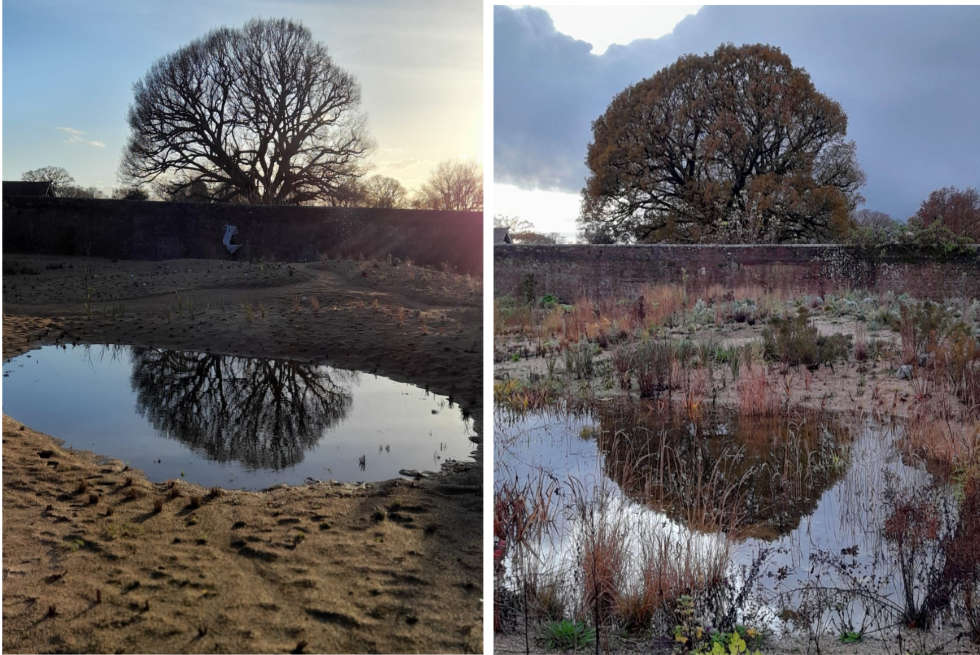
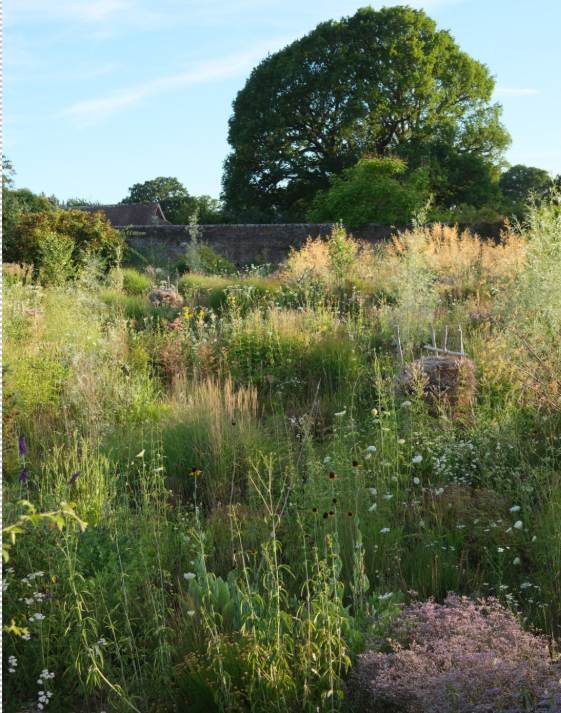
In our Rewilded Garden many of the plants in and around the ephemeral pond seem unperturbed by their submersion. having adapted to withstand both wet and dry conditions. Wild volunteer plants that favour these environments often need the dry period for their seeds to germinate. Creeping buttercups (Ranunculus repens) have large, air-filled channels in their roots and stems (aerenchyma) which enable them to breathe in the low-oxygen conditions and stops the leaves from deteriorating. They populate the base of the pond all year round. Some plants change the morphology of their leaves so they become thinner whilst underwater, and thicker and waxier when the habitat dries out. Some of the plants we introduced, such as Siberian iris, purple loosestrife, and camas (Iris siberica, Lythrum salicaria, Camassia leichtinii) grow from rhizomes, tubers or expanded or fibrous roots that have thick cuticles to withstand the wet and the dry. Common rush, (Juncus effusus) is a common wetland plant with tough leaf blades and hollow stems that give winter shelter to insects and protect eggs. Like Chinese silver grass (Miscanthus sinensis), which also grows here, common rush has deep and dense root systems that are adapted to the comings and goings of standing water. Together, they bring summer and winter interest to this part of the garden as well as wildlife habitat.
Besides all the benefits the ephemeral pond provides for wildlife and the contribution it makes to the mosaic structure of the garden by providing yet another microclimate and community of plants – it is beautiful. Whether we’re watching a thousand bulls-eye rings form from every leaping rain drop or seeing the sunset behind the Knepp oak beyond the garden wall reflected in the mirrored water, it’s all the more precious for being temporary and unpredictable.
Photos courtesy of Joshua Chalmers and Charlie Harpur.
What we’re reading:
Snowdrops at Hyde 2026 – Horsfall House
Ponds – Freshwater Habitats Trust
The Pond Manifesto Layout 1
Tadpole Shrimp – Bug Directory – Buglife
Dig Small Ponds and Scrapes – How to Rewild
Survival of Ranunculus repens L. (Creeping Buttercup) in an Amphibious Habitat – PMC
Garden Tips: March 2025
It’s been about six centuries since white storks and red kites have encountered one another in the UK.
We are looking for dynamic, enthusiastic and passionate Front of House staff with a passion for great service, produce and sustainability to join our growing

Isabella Tree catches up with two of the White Stork Project volunteers, Tim Morgan and Rosemary Dewan, as they prepare food for the non-flying storks
Knepp Wildland Safaris, our gardens and campsite are all about the quiet and patient observation of nature.
Some of the species we are likely to encounter are shy or can be frightened by loud noises or sudden movements. Our campsite with open-air fire-pits, wood-burning stoves and an on-site pond is unsuitable for small children.
For this reason, our safaris, garden visits, holiday cottages and campsite are suitable only for children of 12 and over.

You’ll receive relevant offers and news by email. This will include information about the Rewilding Project, online store products, the Wilding Kitchen Restaurant / Cafe, and other exciting experiences / events across the Knepp Castle Estate. For more information, view our Privacy Policy.